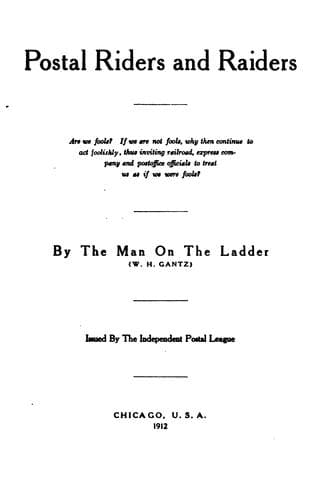
Postal service -- United States -- Second-class matter
But, it is not quite so bad as it looks for the very reason that our
“postal agreements” recognize the “tariff wall” that is built around
_certain_ “infants” in this country. Your goods from England, Germany
or Mexico must be of our “_free_ list” kind, otherwise they must pay a
rake-off to the government. As that is pretty stiff, _you_ don’t order
many parcels from abroad. You buy home products--_thus paying the tariff
rake-off to the protected “infant” instead of the Government_.
Does it not appear that we American citizens are an easily “worked” bunch?
In connection with the tabulation just presented, should be noted
the fact that _millions_ of our people live in non-railroad
communities--live, often, _many miles from any express office_, while
a postoffice may be near. If these people have pressing need for any
article of merchandise weighing over four pounds it cannot reach them,
under existing law, by mail. _They must order it sent by express and make
the long drive to the nearest express office to get it._
The article may be one needed for the health of the family or it may be
a rod, a gear wheel or other part of some machine that has broken in a
critical hour of need--_any one of a hundred needs_, delay in supplying
which _costs money_.
It was carefully figured in 1900 that our rural, non-railroad communities
alone lost $90,000,000 _a year_ in excessive express charges and delays
in delivery by reason of the peculiar if not studied apathy of their
government in the matter of furnishing even a _reasonably_ adequate
domestic parcels post service.
The hypothetical rate (1 cent a pound or $20.00 per ton), for parcels
carriage and delivery by post is low--maybe a little too low. If so, it
is only a very little, _if it is figured to have the rate cover only
the actual cost of the service_. A nation-wide parcels post service, if
properly organized and directed, would, it must be remembered, handle
all the short as well as the long haul business. It would not, as
now, permit a collusive raiding arrangement between the railroads and
the express companies by which the latter get most of the short-haul
shipments and leave most of the long-haul parcels to be handled by the
mail service.
Public-domain text, read in full here on John Shaqi.
Reviews
Reviews
No reviews yet
Be the first to share your thoughts on this work.
Elsewhere in the archive
Join the Discussion
Join the discussion
Sign in to leave a comment or review.
Sign InorCreate an account