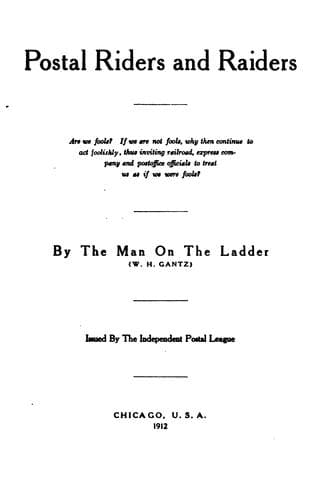
Postal service -- United States -- Second-class matter
That it was the intention of the legislators of that time to make the
carriage, handling and delivery of letters and “packets” (small parcels
or packages of any sort of mailable matter), a government monopoly, there
can be no valid reason to doubt. That the express companies have operated
and are operating in violation of Section 181 of that law, there can be
no valid reason to doubt. That Section 181 of the enactment of 1845 is
good, sound law today, there can be no valid reason to doubt. That the
express companies have operated, and continue to operate, in violation
of that law--in open defiance of it--and are therefore engaged in a
_criminal_ traffic, there can be no valid reason to doubt.
True, they have a very peculiar court decision to protect them in their
violation of that law. I call it a “peculiar” decision. A more fitting
term might be used in describing that court decision, and the use of such
a term would be fully justified.
One of the two actions which Congress might take would be to amend
Section 181 of its Revised Statutes so that even a yokel, as well as
a Federal Judge, may clearly see that the carriage of _packages and
parcels_, as well as of “packets,” which do not exceed the maximum
regulation weight and are of mailable class and kind, is “intended” to be
the _exclusive privilege of the government_.
Such an amendment to the law would force the express companies out of
business.
The other action which could be effectively taken would be to make the
parcels post rate so low and the maximum weight of parcels so liberally
high that the railroads and express raiders would quit of their own
accord, which they would do as soon as their present tonnage of loot is
seriously cut down. Nothing would cut into that lootage deeper or quicker
than would a service rated and weighted parcels post.
I have been severe in my strictures and condemnation of the express and
railway raiders. In evidence that my condemnation is deserved I desire to
quote two or three people--people who have made a careful, painstaking
study of the game these raiders have played, and yet play, and of the
practices and tricks which make it a “sure thing” for the high-finance
gentlemen who play it.
Mr. Albert W. Atwood wrote a series of three most informative articles
for the American Magazine under the caption, “The Great Express
Monopoly.” They appeared in the American in its issues for February,
March and April, 1911. I trust the publishers will not take unkindly my
quoting Mr. Atwood. He presents some facts which so conclusively evidence
several points that I cannot resist the appeal they make for quotation.
In evidencing the fact that the railroads own and control the express
companies and also showing how that ownership and control was obtained
and is maintained, Mr. Atwood writes as follows:
Public-domain text, read in full here on John Shaqi.
Reviews
Reviews
No reviews yet
Be the first to share your thoughts on this work.
Elsewhere in the archive
Join the Discussion
Join the discussion
Sign in to leave a comment or review.
Sign InorCreate an account