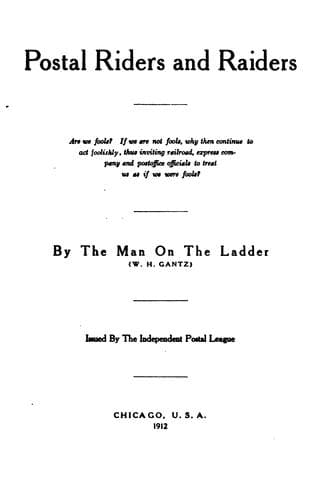
Postal service -- United States -- Second-class matter
In speaking to the same point as applied to the United States Express
Company, Mr. Atwood calls attention to the fact that 55 per cent of its
“stockholders” have entered suit to wind up the company’s affairs on
charges of mismanagement by its dominating officers. Mr. Atwood further
writes:
Although the gravest of charges of mismanagement and waste of
assets have repeatedly been made against the directors of the
United States Express Company, a profit of almost 15 per cent
was earned by the company on the capital invested in the express
business in the year 1909. This profit would have been still
greater had general trade been normal, and had there not been a
hiatus between the loss of one large contract and the securing of
another. That the stockholders have not received all the profits
proves nothing. Millions have gone into unnecessary real estate
investment and large salaries have been paid, but earnings on the
capital actually invested have clearly shown that even under a
management whose good faith and ability is being challenged in
the courts there is an ample return.
As long ago as 1875 a writer in Harper’s Magazine said the
express business had already created fifty millionaires, a
statement which does not tax the credulity of anyone who casts
a glance at the dividend record of these companies. To use the
calmly judicial words of the Census Bureau: “In no other business
is it probable that so little money, comparatively, is invested
where the gross receipts are so large.” We have seen that new
capital is not a necessity of the express business. Unlike the
railroads, new security issues to raise capital are never sold to
the investing public.
The cappers for railroad and express interests, keep the atmosphere
agitated with talk about the “uncertainty and irregularity” of the
quantity of express matter to be carried, “the excessive taxes paid,”
etc. In answer to such bubble, Mr. Atwood has this to say:
While this may be theoretically true, the experience of years
has shown that the patronage of these companies has been fairly
regular, remunerative and growing. Not only will a study of the
gross receipts prove this contention, but further confirmation
will be found in the remarkable series of excessive dividends.
“We do not feel that any extravagant return should be permitted
upon the business of these companies,” said the Interstate
Commerce Commission in Kinde _v._ Adams _et al._, “for it
involves none of the elements which entitle an investment to a
high return.”
Public-domain text, read in full here on John Shaqi.
Reviews
Reviews
No reviews yet
Be the first to share your thoughts on this work.
Elsewhere in the archive
Join the Discussion
Join the discussion
Sign in to leave a comment or review.
Sign InorCreate an account