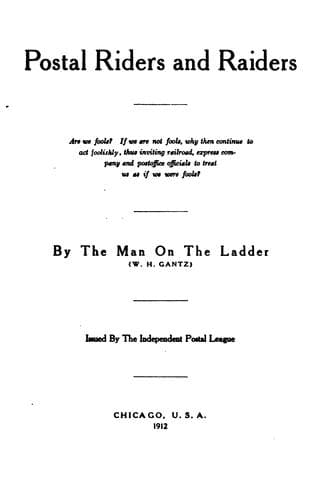
Postal service -- United States -- Second-class matter
Nor did he do that only. He told me the price of the “web press roll”
and of “flat-print” papers into which the wood pulp is made, paper stock
on which is printed all our periodicals--both newspapers and monthly
and weekly periodicals. Next he told me of the price of composition,
(typesetting, as we used to call it), by the most modern methods, the
linotype and the monotype machines. Then he talked of ink and presswork
costs, of color work, folding, stitching and covering or binding; of the
cost of wrapping, addressing, cartage, rail haulage and distribution.
The result of the expert’s showing of the _cost_ of raw material and of
skilled and other labor in periodical publication, as the periodicals are
printed and marketed today, was to the effect that the reader gets his
daily, weekly or monthly publication, on an average, _at less than half
what it costs the publisher to produce it_.
Further, it was conclusively shown to me, that the publisher’s _net_
receipts for a newspaper, magazine or other periodical is often but a
third, sometimes less than _a fourth_, of the net cost to him of its
production and distribution.
With this preliminary, we will now go back to our magazine of 650,000
monthly issue and Postmaster General Hitchcock’s estimate of its profits.
Postmaster General Hitchcock’s talk of “gross” receipts of $6,000,000
a year is ill advised. Let us see what must be charged off from that
$6,000,000 before the publisher can count his profits.
First, we will figure the publisher’s loss on published copies. Taking
only the flat cost of paper, ink and composition; of the cost of fine
color and half-tone pages such as monthly periodicals must print; of
cover designing, presswork, and binding, of wrapping and addressing, say
150,000 copies of the monthly issue to individual addresses, that being,
approximately at least, the number of subscribed readers the publisher
will have on a total issue of 650,000 copies. Next comes the cost of
sacking his subscribed circulation and of bundling and wrapping, then
of cartage to mail trains. The prominent periodical publisher not only
delivers his subscribed list _sacked_ to the mail car, but he _routes_
the larger portion of it, the railway mail clerks having nothing to do
with it save to dump it off at the designated stations. Then he must
meet the carriage and delivery cost, about 1 cent a pound, or $20.00
a ton. All these I consider _flat_ costs of producing and delivering
the publication. To this flat cost must be added the expenditures for
contributing writers, for editors, proofreaders and special investigators
(including travel and other expenses), stenographers, postage and
stationery for a large correspondence, clerical, messenger and other
administration service, rents, insurance, etc., etc. And, finally, the
expenditures made in the way of commissions and premiums to work up a
subscribed issue.
Public-domain text, read in full here on John Shaqi.
Reviews
Reviews
No reviews yet
Be the first to share your thoughts on this work.
Join the Discussion
Join the discussion
Sign in to leave a comment or review.
Sign InorCreate an account