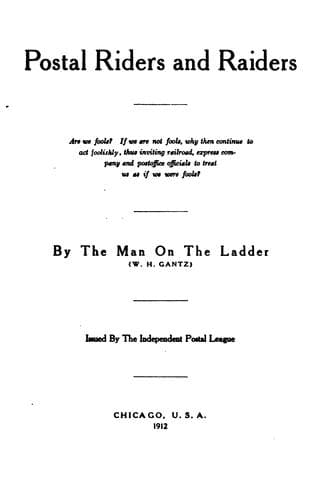
Postal service -- United States -- Second-class matter
Well, this gentleman summoned me off the ladder, and “called” me in a way
which made my landing somewhat abrupt, in order to tell me some things
about periodical publishing which he had shrewdly, likewise correctly,
guessed that I did not know.
Among the things he told me, not only told me but proved to me, was the
one stated: that readers of periodicals get, _in net mechanical cost,
more than the publishers receive for the publication sold_.
In proof of this he cited the 8-page dailies issued in cities of the
second and third classes, and the 16 to 32-page dailies published in
our metropolitan cities; also the great “Sunday Editions” issued by the
latter, issues which run more largely to color and _tonnage_ than to news
and literature. The former, (the dailies), my publisher friend pointed
out, realize about _six-tenths of one cent a copy_--a little less, if
they do cartage for any considerable part of their local deliveries or
pay rail haulage charges on outside deliveries. Of course, my tutor
is speaking of news agents and carrier deliveries. On their regular
subscribed issues publishers realize a little more. But the difference,
when cost of wrapping and addressing is figured, is so trifling as not
to be worth considering. It can be safely figured that the net price
received by the publisher of a newspaper is six-tenths of one cent
for the daily and about three and a half cents--probably nearer three
cents--for the leviathan metropolitan Sunday edition.
Just here is where my publisher friend’s knowledge of _market costs_ came
forth for my enlightenment and, I sincerely hope, for my reader’s as
well. Having studied his business from the “stumpage” up, so to speak, he
began with the cost of pulp wood timber, “of stumpage,” from the spruce
forests of the north and farther north, the scattered linn or basswood
of the east and southeast, and of the soft maple and cottonwood of the
southeast and south. Then he told me of the prices paid the “lumber
jacks” to fell and saw this pulp-wood; of the cost of hauling it by ox,
mule or horsepower to the river “roll-way,” which river would carry it
down to the pulp mill, or hauling it to the railroad loading station for
rail carriage to the same point.
Public-domain text, read in full here on John Shaqi.
Reviews
Reviews
No reviews yet
Be the first to share your thoughts on this work.
Join the Discussion
Join the discussion
Sign in to leave a comment or review.
Sign InorCreate an account