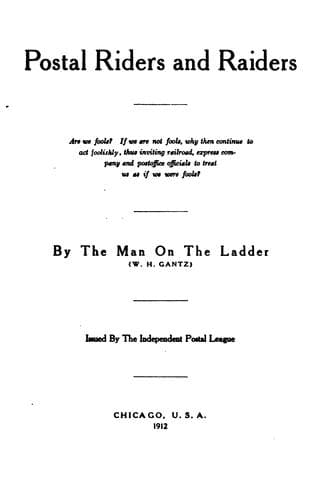
Postal service -- United States -- Second-class matter
This commission was authorized by Congress to make inquiry regarding
second-class mail matter. The reader may remember that I made reference
to this report on a previous page. It presents much information and
collated data, which, if Mr. Hitchcock had studiously read would
have enabled him to avoid many of the egregious blunders he has made
at frequent intervals during the past two years when discussing the
subject. It would, at any rate, have prudently curbed or restrained
what appears in Mr. Hitchcock to be a native or acquired tendence to
volume or tonnage in talk when he is speaking of second-class mail
matters or of the publication and distribution of periodical literature.
I do not concur in a number of the conclusions of this commission as
presented in its report, but no fair-minded man can read that report
without being convinced that the commissioners delved into the subjects
of the classification of second-class mail matter and the cost, to
the government, of its haulage and handling most earnestly; also as
thoroughly and as deeply as the _lack of organization in the Postoffice
Department and its antiquated, careless and inaccurate accounting_ left
it possible for anyone to go.
This commission began its sessions in New York, October 1, 1906. It sent
advance notice to all the organizations of publishers in the country,
to publishers not in organization, to editorial associations, to boards
of trade, mercantile, commercial and trades associations and to other
individuals and organizations that might be interested, directly or
indirectly, in the subject matter to be investigated. It invited them
to present their views, complaints, objections and suggestions in
writing and also to send representatives to present their views and
their grievances, if any, to the commission in person. The notice
and invitation of the commission met with a large response from the
newspapers and other periodical publishers, also from other individuals
and associations interested in the distribution of periodical literature
by reason of the commercial, educational, religious, fraternal,
scientific or other benefits such literature conveyed to the people.
At the suggestion of this commission, the Postoffice Department prepared
and delivered to it “an elaborate statement with exhibits” to show the
“defects of the existing statute as developed in _actual operation_.”
Also, the then Postmaster General, Mr. George B. Cortelyou, his Second
Assistant, Mr. W. S. Shallenberger, and his Third Assistant, Mr. Edwin C.
Madden, prepared and presented personal statements to the commission.
Public-domain text, read in full here on John Shaqi.
Reviews
Reviews
No reviews yet
Be the first to share your thoughts on this work.
Elsewhere in the archive
Join the Discussion
Join the discussion
Sign in to leave a comment or review.
Sign InorCreate an account