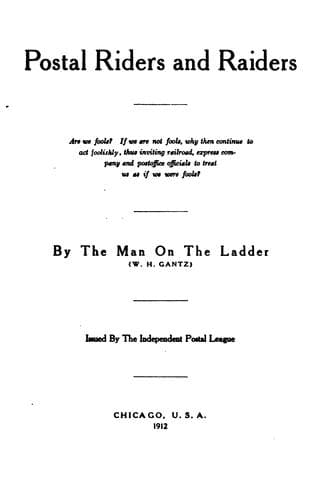
Postal service -- United States -- Second-class matter
The testimony taken by the commission at these hearings, with
statements submitted in writing by publishers not orally heard,
boards of trade, and the like, and other data collected by the
commission in the course of its investigations, _together with a
complete digest of such testimony, are embodied in the record of
its proceedings submitted with this report_.
To the end of getting our corner stakes properly located in order to
run our lot-lines correctly, I desire to quote further from the report
of this 1906-7 commission. It says some pertinent things and _says
them hard_. Before quoting, however, I desire to amplify a little on
the character of that commission, on the general character of the men
composing it as indicated in their official and public action.
The first point of interest for us commoners to note and appreciate is
that the photographs of none of them, so far as I have been able to
learn, have appeared in the rogues’ gallery. We may therefore presume
that they are not only intelligent but “square” men--men worthy of Mr.
Hitchcock’s consideration and respect as well as our own.
The second point worthy of note in considering the personnel of that
commission is that none of them, so far as public reports show, ever
had the advantages and opportunities of acquiring that peculiar and
specialized knowledge of federal postal affairs, second-class or other,
which may accrue to men from a postgraduate course in national party
management.
In this connection, however, it may be said that some members of the
commission may have come _near_ to such unusual opportunities as
just mentioned for acquiring expert knowledge of the classification,
transportation and handling of second-class mail.
It is also fitting for me to say in speaking of the gentlemen composing
that 1906-7 commission that, so far as I have been able to look up their
biographies in the Congressional Directory and elsewhere, I find nothing
to indicate that any of them ever tried to rob a smokehouse nor have
any of them ever tried to put over any piece of “frame-up” legislation
of the nature of Mr. Hitchcock’s “rider,” printed on a previous
page--_legislation to hobble, punish or ruin periodicals honest enough
and independent enough to tell the truth to a hundred millions of people_.
The foregoing are some of the reasons--there are many others--why I
think the membership of that Penrose-Overstreet Commission of 1906-7 was
possessed of an ability, character and qualification to have commanded
Mr. Hitchcock’s careful consideration of the information and data the
commission so carefully collated, after thorough investigation, and
submitted with its official report.
“Maybe he did make a careful study of that collated data?”
Public-domain text, read in full here on John Shaqi.
Reviews
Reviews
No reviews yet
Be the first to share your thoughts on this work.
Elsewhere in the archive
Join the Discussion
Join the discussion
Sign in to leave a comment or review.
Sign InorCreate an account