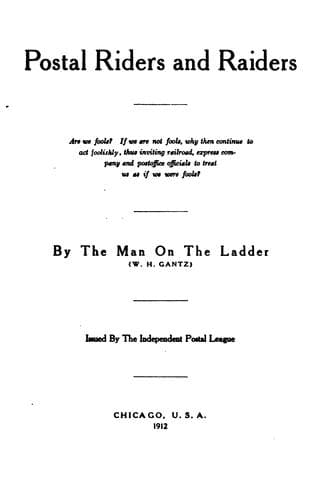
Postal service -- United States -- Second-class matter
The representative of the _American Newspaper Publishers’
Association_, speaking for the metropolitan daily press, stated
that less than _6 per cent of their circulation went into the
mail at all_, in many instances the proportion being as low as
two-thirds of 1 per cent; that the radius of circulation was not
more than 150 miles; that their mailings averaged _49 pounds per
sack_, and that 93 per cent of all second-class matter going out
of New York city, for example, _was already sorted and routed_.
It was admitted, however, that while the newspapers _avail
themselves of express and railway transportation_ for matter
sent out in bulk, single copies sent to individual subscribers
invariably went by mail.
Postmaster General Hitchcock appears to have largely ignored the fact so
clearly pointed out by the publishers in 1906--yes, pointed out as long
ago as 1898--that second-class mail matter is a _large producer of the
revenues_ received by the government from mail matter of the first, third
and fourth classes. Following is a summary of what the publishers pointed
out to the 1906-7 commission:
There is an immense indirect revenue on second-class matter, due
to the fact that second-class matter is itself the cause of a
great volume of first-class matter, upon which the department
reaps a handsome profit. While the extent to which first-class
matter is thus indebted to second-class matter is necessarily
indeterminate, attempts were made to illustrate it by particular
instances. This was done by computing the amount of first-class
mail arising, first, from the direct correspondence between a
publisher and the readers, and secondly, from correspondence,
between the readers and the advertisers, resulting from the
insertion of the advertisements. In the instances chosen,
the first-class matter thus stimulated appeared to be very
considerable. Upon this basis it was argued that any reduction in
the volume of second-class matter would inevitably be followed by
a corresponding reduction in first-class matter. This would not
only deprive the Postoffice Department of the revenue from the
first-class matter, _but by diminishing the total weight of the
mails would correspondingly increase the rate of mail pay_, so
that the net result of the elimination of the socially valuable
second-class matter would be an actual increase in the total cost
of the service.
Public-domain text, read in full here on John Shaqi.
Reviews
Reviews
No reviews yet
Be the first to share your thoughts on this work.
Elsewhere in the archive
Join the Discussion
Join the discussion
Sign in to leave a comment or review.
Sign InorCreate an account