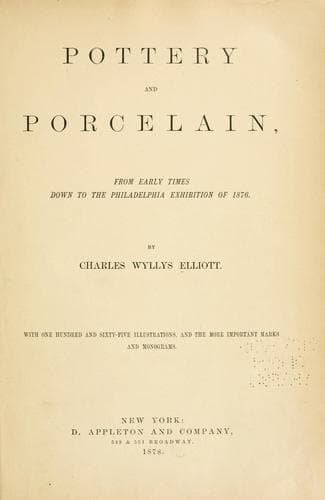
Pottery and Porcelain, from early times down to the Philadelphia exhibition of 1876Elliott, Charles Wyllys
History
Pottery and Porcelain, from early times down to the Philadelphia exhibition of 1876
Elliott, Charles Wyllys
Pottery -- History; Pottery -- Marks
We do not know how to spell their names in our letters, and they vary
infinitely; so too the inscriptions upon their plates and dishes vary
with the knowledge and the fancy of the translator. Of course, we
approximate to the truth, but not more; for no two Chinese quite agree
as to what this most flexible writing may mean. As to dates on the
pieces, some certainty seems to have been reached; and such is valuable.
I have added to this article _marks_ and dates as now understood by the
best authorities in England, and as arranged by Mr. A. W. Franks, who is
the latest writer upon the subject. The knowledge of these helps the
student, and is valuable to the collector.
[Illustration: FIG. 96.--_Pou-tai, "The God of Content."_]
The opening cut (Fig. 96) in our chapter shows the Chinese god
Pou-tai--the "God of Content." He is described as "corpulent, his chest
uncovered, mounted upon or leaning on the wine-skin which holds his
terrestrial goods; his face, with half-closed eyes, beaming with an
eternal laugh."
His image, done in porcelain, is found in the workshops of China, where
men wish more than they can obtain; he allays, perhaps, but does not
quench. This image would be most useful--at least, most suggestive--if
it could be set up in every _bourse_ of the Western world.
[Illustration: FIG. 97.--_The Porcelain Tower at Nanking._]
The Nanking Tower (Fig. 97) once stood near the city of Nanking, from
which city much of our finest porcelain comes. It was built with bricks
or pottery, the face of which was coated with a dip or slip of
porcelain; and the whole thing was valuable and interesting as a
monument of the potter's art. It is now razed to the ground, the last
destruction being that of the Taiping rebels.
The history of pottery is in a good degree the history of man. All
nations have done something in this way, from the rude clay pots of the
barbarians, through the gayly-painted dishes of the incipient
civilization, up to the culmination of the art, when perfection seems to
have been reached in China through the centuries extending up to the
sixteenth. This manufacture, which reached in China and Japan to the
point of finest art, has not been surpassed by any civilized race, if
equaled. I am unable to do anything but admire a people whose workmen
did and liked to do such fine and faithful work, and found such large
patronage for it; and it seems a ludicrous and stupid judgment for us,
who admire and pay for the sculptures of Mr. Mills and Miss Ream, to
call those peoples barbarians!
Are they not justified in calling _us_ "outside barbarians?"
This chapter will treat briefly upon these Oriental productions, and I
hope no apology is needed.
Public-domain text, read in full here on John Shaqi.
Reviews
Reviews
No reviews yet
Be the first to share your thoughts on this work.
Elsewhere in the archive
Join the Discussion
Join the discussion
Sign in to leave a comment or review.
Sign InorCreate an account