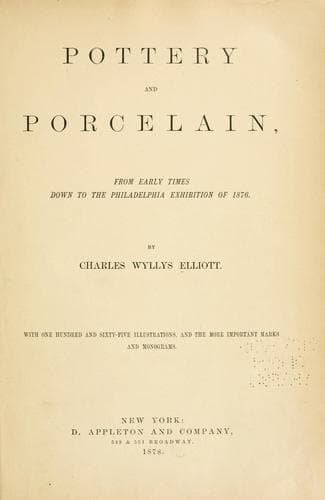
Pottery and Porcelain, from early times down to the Philadelphia exhibition of 1876Elliott, Charles Wyllys
History
Pottery and Porcelain, from early times down to the Philadelphia exhibition of 1876
Elliott, Charles Wyllys
Pottery -- History; Pottery -- Marks
We have tried free schools, free trade, free press, and no one is happy.
I pray we may for a century fairly and fully try household art: that is
the art which shall make the home the most attractive place on this
footstool of heaven.
In this work all sects and sexes may unite. Every man and woman can and
will agree that his or her home shall be a page from the book of
paradise; one on which they can write, and one from which all may read.
According to the best authorities we are able to get, we conclude that
the Japanese have from the earliest days been great potters, and that
the Chinese discovery of porcelain was carried to Japan probably in the
century before our era.
It appears from the researches of Dr. Hoffman, of Holland, that in 662 a
Buddhist monk introduced the secrets of translucent porcelain into the
province of Idsoumi, and a village then became famous as _To-ki-moura_,
"village for making porcelain."
In the year 859 the two provinces of Idsoumi and Kavatsi went into a
violent quarrel over a mountain which contained clay and firewood.
But the vast wants of such a tasteful and teeming people as the Japanese
advanced this most useful and beautiful industry until the time of
Katosiro (in the 1200's), when it went forward to perfection, and
rivaled or excelled the best work of China.
In later years the great centre of porcelain-production has been the
island of Kiushiu.
Upon the Idsoumi-yoma (or Mountain of Springs), where was found the
kaolinic clay, Dr. Hoffman numbers some five-and-twenty shops famous for
porcelains.
From the recent work of Messrs. Audesley and Bowes, it seems that the
province of Hizen has produced the finest examples of Japanese
porcelain. The first number of this work has just reached us, and gives
great promise. The authors are Mr. George Ashdown Audesley, architect,
and James Lord Bowes, President of the Liverpool Art Club. No work upon
the ceramic art has appeared superior to this, especially in its
decorations.
[Illustration: FIG. 115.--_Japanese Vase._]
While the fine, delicate perception and touch of the Japanese have given
an added grace and finish to most of their work, as a whole their
porcelain may be said to be a following (rather than a copying) of the
Chinese: in China porcelain was indigenous; in Japan it was an
importation. In China, then, we shall find more original invention and
greater variety; in Japan, more finish. The best work of Japan is often
superior in the paste and in the glaze to the Chinese. As to
classification, it is found that the two styles of China porcelain
called "The Chrysanthemo-Pæonienne" and "The Famille-Rose" are the two
which most prevail in Japan; and it is not easy to distinguish the fine
work of the one country from that of the other.
In the rose family is to be found much of the best work of Japan. In
Figs. 115 and 116 are two good examples of this work.
The "Famille-Vert," or green, was not made there.
[Illustration: FIG. 116.--_Tea-Caddy._]
Public-domain text, read in full here on John Shaqi.
Reviews
Reviews
No reviews yet
Be the first to share your thoughts on this work.
Elsewhere in the archive
Join the Discussion
Join the discussion
Sign in to leave a comment or review.
Sign InorCreate an account