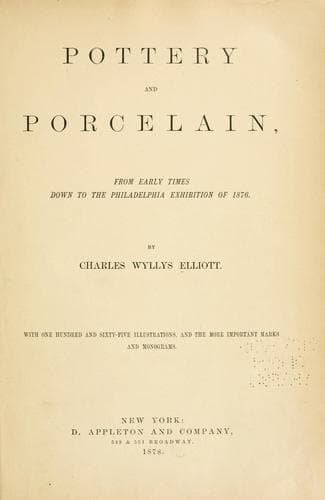
Pottery and Porcelain, from early times down to the Philadelphia exhibition of 1876Elliott, Charles Wyllys
History
Pottery and Porcelain, from early times down to the Philadelphia exhibition of 1876
Elliott, Charles Wyllys
Pottery -- History; Pottery -- Marks
Not only were these articles in relief and of great beauty made here,
but also very excellent, creamy, soft porcelain painted on the flat, and
exquisitely painted, too. The specimens I have seen have a character of
their own, which has the great merit of being indigenous and not an
imitation. The tea-services, of which we now and then see single pieces,
are lovely.
[Illustration: FIG. 144.--_Capo di Monte._]
Mr. Prime has some excellent pieces, of both styles; as has Mr. Wales,
from whose collection we have engraved our illustrations.
The three pieces marked Fig. 142, 143, and 144, are painted on the
glaze, and are exquisite both for design and color.
The single vase (Fig. 145) has two bands, most delicately modeled and
painted in relief.
[Illustration: FIG. 145.--_Capo di Monte._]
Work was continued with more or less success until 1821, when the moulds
were sold to the Doccia manufactory, at Florence; but after 1780 hard
paste was made at this factory, under the patronage of King Ferdinand.
The marks used are here given; the earliest was a ruder form of
_fleur-de-lis_. This _fleur-de-lis_ mark was also used at Madrid, and,
as the work was almost identical, it is not easy to distinguish them.
Demmin says the marks on the hard porcelain were a crown, under which
were sometimes the locked letters RE or FK.
Marks of Capo di Monte:
[Illustration: _About 1786._]
[Illustration: _About 1759._]
[Illustration: _About 1759._]
[Illustration: _Ferdinandus Rex (1780)._]
[Illustration: FIG. 146.--_Buen Retiro._]
SPANISH PORCELAIN--BUEN RETIRO.--When Charles III. came to the throne of
Spain in 1759, from Naples he brought with him many of the workmen and
much of the skill which had produced the beautiful china at Naples.
These he established near his palace of _El Buen Retiro_, at Madrid, and
here his experiments and the manufacture were carried on with great
secrecy and much care. A letter from Spain, written in 1777, quoted by
Marryat, says: "In the gardens of Buen Retiro the monarch has
established a china manufactory, which strangers have not hitherto been
permitted to examine. It is undoubtedly intended that experiments shall
be secretly made, and the manufacture brought to some perfection before
it be exposed to the eyes of the curious. Its productions are to be seen
nowhere except in the palace of the sovereign, or in some Italian
courts, to which they have been sent as presents," etc. During the
Napoleonic wars, when Spain was overrun with troops, the factory was
destroyed (1812), and it has not been restored.
The single illustration (Fig. 146) is a very beautiful small vase, from
Mr. Wales's collection. It is exquisitely painted, and closely resembles
the porcelain of Capo di Monte.
Marks supposed to have been used at Buen Retiro:
[Illustration: _The same as Ludwigsburg._]
[Illustration: _The same as Capo di Monte._]
[Illustration]
Some porcelain has been, and I believe still is, made at Alcora.
Public-domain text, read in full here on John Shaqi.
Reviews
Reviews
No reviews yet
Be the first to share your thoughts on this work.
Elsewhere in the archive
Join the Discussion
Join the discussion
Sign in to leave a comment or review.
Sign InorCreate an account