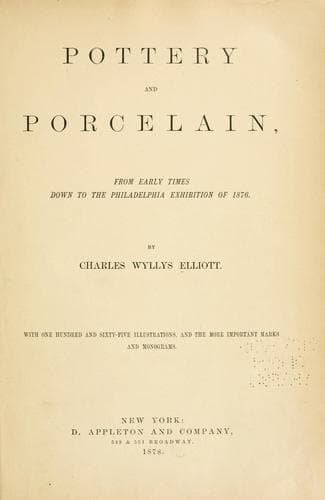
Pottery and Porcelain, from early times down to the Philadelphia exhibition of 1876Elliott, Charles Wyllys
History
Pottery and Porcelain, from early times down to the Philadelphia exhibition of 1876
Elliott, Charles Wyllys
Pottery -- History; Pottery -- Marks
As to porcelain, Russia has not done much, but yet
something.
The Government of Russia, inspired, like the rest, after the success at
Dresden, with the desire to produce fine works, at once made efforts to
secure the services of accomplished men to establish a porcelain-manufactory.
This appears to have been done in the year 1744, by the Empress
Elizabeth Petrovna, when good porcelain was produced, probably in small
amount. In 1765, however, the Empress Catherine II., with her accustomed
restless energy, threw herself into the competition. She enlarged the
works and secured whatever was possible of artists and workmen, and
produced some of the finest porcelains of Europe. The clays used appear
to have been wholly Russian, and her market was mostly with the rich
nobility of her own kingdom. Still the china-fanciers of all Europe,
then even more eager than now, purchased the Russian work; and it is
found in good collections, though but little of it is offered for sale.
M. Demmin quotes from a Russian work of 1773: "Il existe une fabrique de
porcelaine, située sur la Néva, route de Schlüsselburg, à quatorze
versts de Pétersbourg. Elle fabrique des porcelaines tellement belles et
fines, qu'elles ne le cèdent en rien à la porcelaine de Saxe, soit pour
la blancheur et la finesse de l'émail, soit pour la beauté du décor. Sa
blancheur est même supérieure à celle de Meissen. Le directeur,
l'inspecteur, tous les maîtres et ouvriers sont à la solde de la cour,"
etc.
The porcelain has a fine glaze, the paste being hard and slightly
bluish; the decorations usually highly finished in the styles prevailing
at Dresden.
[Illustration: FIG. 161.--_Russian Porcelain._]
The piece shown in Fig. 161 is a teapot, of superior glaze and finish,
from Mr. Wales's collection; the handle and spout are peculiar,
finishing, as they do, with the neck and head of a bird, ending at the
base of the spout in a small wing-decoration. The paste, the glaze, and
the painting of the teapot and the cup and saucer are excellent.
The Russian marks most used are:
[Illustration: _A mark in blue, supposed to be an early one._]
[Illustration: _The Empress Catherine II.'s mark (1762 to 1796)._]
[Illustration: _The Emperor Paul's mark (1796 to 1801)._]
[Illustration: _The Emperor Alexander I.'s mark (1801 to 1825)._]
[Illustration: _The Emperor Nicholas's mark (1825 to 1855)._]
[Illustration: _The mark now is a crown, with the letter A in script,
Alexander II._]
TVER.--About 1787 an Englishman named Gardner made some porcelain at
Tver, of which so little is to be obtained that it is hardly known in
collections. His mark seems to have been [illustration: symbol], the
monogram in Russian letters of A. Gardner, and sometimes the full name
in Russian characters.
Public-domain text, read in full here on John Shaqi.
Reviews
Reviews
No reviews yet
Be the first to share your thoughts on this work.
Elsewhere in the archive
Join the Discussion
Join the discussion
Sign in to leave a comment or review.
Sign InorCreate an account