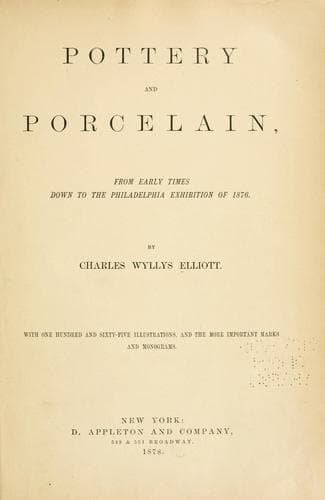
Pottery and Porcelain, from early times down to the Philadelphia exhibition of 1876Elliott, Charles Wyllys
History
Pottery and Porcelain, from early times down to the Philadelphia exhibition of 1876
Elliott, Charles Wyllys
Pottery -- History; Pottery -- Marks
"William Ellis Tucker, my brother, was the first to make porcelain in
the United States. My father, Benjamin Tucker, had a china-store in
Market Street, in the city of Philadelphia, in the year 1816. He built a
kiln for William in the yard back of the store, where he painted in the
white china, and burnt it on in the kiln, which gave him a taste for
that kind of work.
"After that he commenced experimenting with the different kinds of
clays, to see if he could not make the ware. He succeeded in making a
very good opaque ware, called 'queen's-ware.' He then commenced
experimenting with feldspar and kaolin to make porcelain, and, after
much labor, he succeeded in making a few small articles of very good
porcelain. He then obtained the old water-works at the northwest corner
of Schuylkill Front and Chestnut Streets, where he erected a large
glazing-kiln, enameling-kiln, mills, etc.
"He burnt kiln after kiln, with very poor success. The glazing would
crack and the body would blister; and, besides, we discovered that we
had a man who placed the ware in the kiln, who was employed by some
interested parties in England to impede our success.
"Most of the handles were found in the bottom of the seggars[17] after
the kiln was burnt. We could not account for it until a deaf-and-dumb
man in our employment detected him running his knife around each handle
as he placed them in the kiln.
"At another time every piece of china had to be broken before it could
be taken out of the seggar. We always washed the round O's--the article
in which the china was placed in the kiln--with silex, but this man had
washed them with feldspar, which, of course, melted, and fastened every
article to the bottom; but William discharged him, and we got over that
difficulty.
"In the year 1827 my brother received a silver medal from the Franklin
Institute of Pennsylvania, and in 1831 received one from the Institute
in New York. In 1828 I commenced to learn the different branches of the
business.
"On the 22d of August, 1832, my brother William died. Some time before,
he connected himself with the late Judge Hemphill. They purchased the
property at the southwest corner of Schuylkill Sixth and Chestnut
Streets, where they built a large store-house and factory, which they
filled with porcelain. After the death of my brother, Judge Hemphill and
myself continued the working of porcelain for some years, until he sold
out his interest to a company of Eastern gentlemen; but, being
unfortunate in their other operations, they were not able to give the
porcelain attention. In the year 1837 I undertook to carry it on alone,
and did so for about one year, making a large quantity of very fine
porcelain, many pieces of which I still have.
"The gilding and painting are now as perfect as when first done."
Mr. Tucker presented at this time a piece of the work, which is now in
the collection at Philadelphia.
Public-domain text, read in full here on John Shaqi.
Reviews
Reviews
No reviews yet
Be the first to share your thoughts on this work.
Elsewhere in the archive
Join the Discussion
Join the discussion
Sign in to leave a comment or review.
Sign InorCreate an account