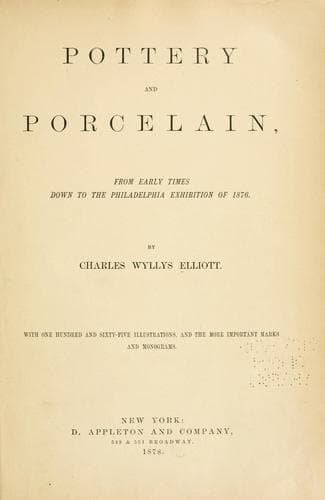
Pottery and Porcelain, from early times down to the Philadelphia exhibition of 1876Elliott, Charles Wyllys
History
Pottery and Porcelain, from early times down to the Philadelphia exhibition of 1876
Elliott, Charles Wyllys
Pottery -- History; Pottery -- Marks
"A memorial of Samuel Dennis, dated New Haven, October 9, 1789, to the
General Assembly of Connecticut, shows 'that he is acquainted with the
potter's business, and is about to erect a stone-pottery; and there is
in this country a plenty of clay which he presumes of the same kind with
that from which the queen's-ware of Staffordshire is usually made; and
that he wishes to erect a pottery for the purpose of manufacturing the
finer kinds of ware usually made in Staffordshire, particularly the
queen's-ware,' and he asks the aid of the State in founding the works.
His memorial was negatived, and it does not appear whether he went on
with his project.
"Isaac Hanford, of Hartford, Connecticut, took out a patent, January 20,
1800, for a new method of making bricks, tiles, and pottery-ware in
general, and of discharging the moulds. Nothing further is known of his
work; but coarse pottery has, from the beginning of the century, been
made in Hartford. Prior to 1800 a pottery was in existence at
Stonington, Connecticut, managed by Adam States, who was succeeded in
the business, after 1804, by his sons, Adam and Joseph. They made jugs,
butter-pots, jars of all sizes, and some small wares with handles,
uniformly of soft pottery, usually gray in color, with salt-glaze.
Contemporary with this was a pottery at Norwalk, Connecticut, which made
red wares of soft pottery in many forms. We learn from a lady, whose
memory extends back to 1804, that it made jars and pots of all sizes,
teapots, mugs, and large milk-pans, then in common use among the farmers
in Connecticut, glazed with a lead-glaze, the color deep red with
flashes of black, probably caused by smoke in the firing. Other
potteries produced wares similar to the Stonington and Norwalk.
"From a report of the Secretary of the Treasury (Mr. Gallatin), made in
1810, it appears that the exports of 'coarse earthen-ware' exceeded the
imports. In this report the secretary says that progress has been made
in the manufacture of 'queen's and other earthen ware,' and that 'a
sufficient quantity of the coarser species of pottery was made
everywhere. Four manufactories of a finer kind had lately been
established which made ware resembling that of Staffordshire.' Dr.
Dwight, in his 'Travels' (1822), after quoting the above, states that he
had gained access to the reports from Massachusetts and Connecticut,
upon which the secretary's report had been founded, and gives among the
manufactures of Connecticut for the year, potteries, twelve; 'value of
earthen and stone ware, thirty thousand seven hundred and forty
dollars;' and for Massachusetts, 'earthen-ware, eighteen thousand seven
hundred dollars.'
Public-domain text, read in full here on John Shaqi.
Reviews
Reviews
No reviews yet
Be the first to share your thoughts on this work.
Elsewhere in the archive
Join the Discussion
Join the discussion
Sign in to leave a comment or review.
Sign InorCreate an account