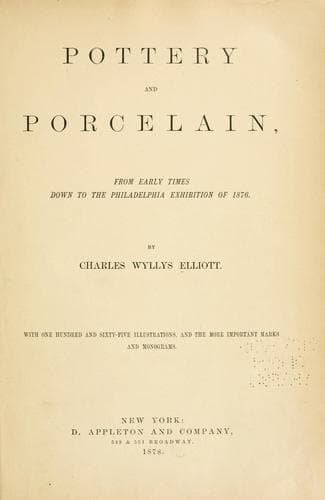
Pottery and Porcelain, from early times down to the Philadelphia exhibition of 1876Elliott, Charles Wyllys
History
Pottery and Porcelain, from early times down to the Philadelphia exhibition of 1876
Elliott, Charles Wyllys
Pottery -- History; Pottery -- Marks
"In 1443 what had been but an unimportant mountain fief was erected into
a duchy, and the house of Montefeltro ruled a fair territory in the
person of the infamous Oddantonio, the first Duke of Urbino. On his
violent death in 1444, Federigo, his illegitimate brother, succeeded to
the dukedom. Of enlightened mind, as well as of martial capacity, he
developed the native capabilities of the country, and gathered about him
at the court of Urbino the science and learning of the period. He built
a noble castellated palace at Urbino, for the embellishment of which he
invited the leading artists of the day. A patron of all art, and a great
collector, he encouraged the manufacture of the maiolica wares which
flourished under his reign. On his death, in 1482, his son Guidobaldo I.
continued his father's patronage to the ceramic artists of the duchy,
although much occupied in the Italian wars consequent on the French
invasion by Charles VIII. Passeri states that fine maiolica (by which he
means that covered with the tin-enamel) was introduced into Pesaro in
1500; and there is some reason to believe that the new process came from
Tuscany. It differed materially in composition and manufacture from the
'mezza-maiolica' wares, to which it was very superior, and was known as
'porcellana,' a name applied at that period in Italy to the choicer
description of enameled earthen-ware. Passeri also states that in the
inventory of the ducal palaces a large quantity of painted 'maiolica'
vases were included under this name. The superior whiteness of the
enamel, more nearly approaching to that of Oriental porcelain, was
probably the reason for its adoption; but we must not confound the term
as used in this sense with its technical meaning in reference to a
decorative design known as 'a porcellana.'"
These famous manufactories of maiolica at Urbino, Gubbio, Pesaro, and
Castel-Durante, sprang into life about the end of the fifteenth and the
beginning of the sixteenth centuries. That of Urbino perhaps took the
lead, being so directly under the patronage of the dukes.
The two most distinguished artists here were _Francisco Xanto Avelli da
Rovigo_ and _Orazio Fontana_; they are commonly spoken of as "_Xanto_"
and "_Fontana_." Besides these were Battista Franco and Raffaelle del
Calle, among the best painters upon maiolica.
Public-domain text, read in full here on John Shaqi.
Reviews
Reviews
No reviews yet
Be the first to share your thoughts on this work.
Elsewhere in the archive
Join the Discussion
Join the discussion
Sign in to leave a comment or review.
Sign InorCreate an account