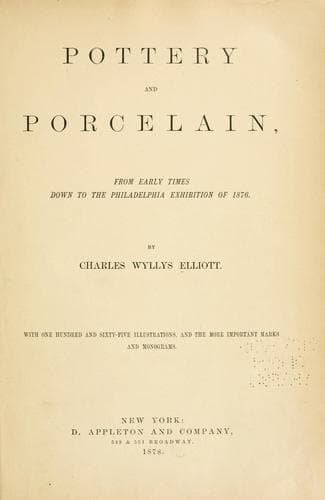
Pottery and Porcelain, from early times down to the Philadelphia exhibition of 1876Elliott, Charles Wyllys
History
Pottery and Porcelain, from early times down to the Philadelphia exhibition of 1876
Elliott, Charles Wyllys
Pottery -- History; Pottery -- Marks
"With regard to the Fontana family, chiefs among Italian ceramic
artists, we quote from the notice by Mr. Robinson appended to the
Soulages catalogue. He tells us that 'the celebrity of one member of
this family has been long established by common consent. Orazio Fontana
has always occupied the highest place in the scanty list of maiolica
artists, although at the same time nothing was definitely known of his
works. Unlike their contemporary Xanto, the Fontana seem but rarely to
have signed their productions, and consequently their reputation as yet
rests almost entirely on tradition, on incidental notices in writings
which date back to the age in which they flourished, and on facts
extracted at a recent period from local records. No connected account of
this family has as yet been attempted, although the materials are
somewhat less scanty than usual. There can be no doubt that a
considerable proportion of the products of the Fontana "boteghe" is
still extant, and that future observations will throw light on much that
is now obscure in the history of this notable race of industrial
artists. Orazio Fontana, whose renown seems to have completely eclipsed
that of the other members of his family, and, in fact, of all the other
Urbinese artists, is first mentioned by Baldi, at the beginning of the
seventeenth century, in his eulogy of the state of Urbino pronounced
before Duke Francesco Maria II.... From documents cited by Raffaelli, it
is established beyond doubt that the original family name was
_Pellipario_, of Castel-Durante, Fontana being an adopted surname; and
it is not immaterial to observe that down to the latest mention of any
one of the family (in 1605) they are invariably described as of
Castel-Durante.... The Fontana were undoubtedly manufacturers as well as
artists, i.e., they were the proprietors of "vaserie." Of the first
Nicola, as we have only a brief incidental notice, nothing positive can
be affirmed; but with respect to his son Guido we have the testimony
both of works still extant and of contemporary documents. We know,
also, that Guido's son Orazio also had a manufactory of his own, and the
fact is established that between 1565 and 1571 there were two distinct
Fontana manufactories--those of father and son. What became of Orazio's
establishment after his death, whether continued by his brother Camillo
or reunited to that of the father, there is no evidence to show. With
respect to the remaining members of the family, our information is of
the scantiest kind. Camillo, who was inferior in reputation as a painter
only to his elder brother, appears to have been invited to Ferrara by
Duke Alfonso II., and to have introduced the maiolica-manufacture into
that city. Of Nicola, the third (?) son, we have only incidental mention
in a legal document, showing that he was alive in the year 1570. Guido,
son of Camillo, lived till 1605; and of Flaminio, who may either have
Public-domain text, read in full here on John Shaqi.
Reviews
Reviews
No reviews yet
Be the first to share your thoughts on this work.
Elsewhere in the archive
Join the Discussion
Join the discussion
Sign in to leave a comment or review.
Sign InorCreate an account