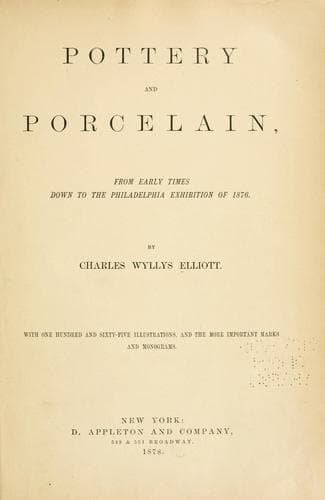
Pottery and Porcelain, from early times down to the Philadelphia exhibition of 1876Elliott, Charles Wyllys
History
Pottery and Porcelain, from early times down to the Philadelphia exhibition of 1876
Elliott, Charles Wyllys
Pottery -- History; Pottery -- Marks
"The celebrated vases made for the _spezieria_ of the duke were produced
at the Fontana fabrique, and subsequently presented to the Santa Casa at
Loreto, where many of them are still preserved. Those shown to the
writer on his visit to that celebrated shrine some few years since did
not strike him as being of such extraordinary beauty and great artistic
excellence as the high-flown eulogy bestowed upon them by some writers
would have led him to expect. The majority of the pieces are drug-pots
of a not unusual form, but all or nearly all of them are 'istoriati,'
instead of being, as is generally the case, simply decorated with
'trofei,' 'foglie,' 'grotesche,' the more usual and less costly
ornamentation. Some of the pieces have serpent-handles, mask-spouts,
etc., but he vainly looked for the magnificent vases of unsurpassed
beauty; nor, indeed, did he see anything equal to the shaped pieces
preserved in the Bargello at Florence. The work of the well-known hands
of the Fontana fabrique is clearly recognizable, and several pieces are
probably by Orazio. Some, more important, preserved in a low press, were
finer examples. We have said that the pieces individually are not so
striking, but, taken as a whole, it is a very remarkable service, said
to have originally numbered three hundred and eighty vases, all painted
with subjects after the designs of Battista Franco, Giulio Romano,
Angelo, and Raffaelle; and, as the work of one private artistic pottery
in the comparatively remote capital of a small duchy, it bears no slight
testimony to the extraordinary development of every branch of
art-industry in the various districts of Italy during the sixteenth
century."
At the period of which we write, Italy had become the leading nation of
Europe in all that pertained to literature and the arts; her painters,
sculptors, and poets, had thrown over her people and history a glory, or
rather a glamour, which was but the iridescence which whispered of
decay. Within a century all had sunk into insignificance and palsy.
To-day the world visits Italy to see with curious eyes what she _has_
been, not what she is.
The art and the maiolica which she now produces are but copies, and too
often bad copies, of that past. The manufactories of _Ginori_ at
Florence, and of _Giustiniani_ at Naples, make much good work; but, so
far as I have seen, they blindly copy the shapes, the colors, and the
decoration, of the fifteenth and sixteenth centuries, and attempt
nothing more. And the pity is that we, who buy to-day, seem to _want_
only those!
In our pursuit of art it may be well to remember that no nation can be
created by "art," and none can be saved by it. When it is enlisted only
in copying the past, it means feebleness and decay.
Public-domain text, read in full here on John Shaqi.
Reviews
Reviews
No reviews yet
Be the first to share your thoughts on this work.
Elsewhere in the archive
Join the Discussion
Join the discussion
Sign in to leave a comment or review.
Sign InorCreate an account