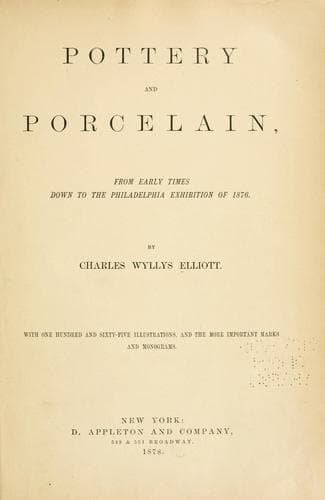
Pottery and Porcelain, from early times down to the Philadelphia exhibition of 1876Elliott, Charles Wyllys
History
Pottery and Porcelain, from early times down to the Philadelphia exhibition of 1876
Elliott, Charles Wyllys
Pottery -- History; Pottery -- Marks
FAENZA.--Under the name of _Faenza_, an old town of Roman Italy, all
sorts of waifs and strays which have no other home are likely to be
classed. Its productions have no such peculiarities as mark those of
Urbino, Gubbio, and some other Italian "botegas." But for the antiquity
and extent of its potteries, and also because it seems to have given the
name "_faience_" to all earthen-ware pottery made in France, it has a
certain importance. I therefore give a single extract from what Mr.
Fortnum has written about it. As there are a considerable number of
these druggist's pots (see Fig. 64) in this country, the matter may be
of interest. He writes:
"From an early period Faenza seems to have produced a large number of
electuary-pots and pharmacy-bottles; a pair are in the Hôtel Cluny, one
bearing the name FAENZA, the other 1500. Many of these vases are
decorated in the style known as _a quartiere_, being divided into
compartments, painted in bright yellow, etc., on dark blue, with
foliated and other ornament, and usually having a medallion with profile
head or subject on one side, under which the name of the drug in Gothic
lettering is inscribed on a ribbon. A curious example is in the British
Museum: a large flask-shaped bottle of dark-blue ground with yellow
leafage and with twisted handles, upon the medallion of which is
represented a bear clasping a column, with the inscription, '_et
sarrimo boni amici_,' allusive, in all probability, to the
reconciliation of the rival houses of Orsini and Colonna in 1517.
Public-domain text, read in full here on John Shaqi.
Reviews
Reviews
No reviews yet
Be the first to share your thoughts on this work.
Elsewhere in the archive
Join the Discussion
Join the discussion
Sign in to leave a comment or review.
Sign InorCreate an account