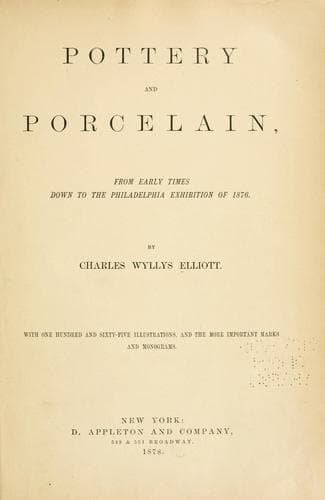
Pottery and Porcelain, from early times down to the Philadelphia exhibition of 1876Elliott, Charles Wyllys
History
Pottery and Porcelain, from early times down to the Philadelphia exhibition of 1876
Elliott, Charles Wyllys
Pottery -- History; Pottery -- Marks
Many of the paintings indicate much taste and skill. It seems to me that
this work is marked by more originality, and by a finer perception of
the fit and the beautiful, than any other French pottery. The pieces
shown in Figs. 82 and 83, as far as engravings can do it, prove this.
They do not show the variety and the richness of color which distinguish
much of the best work.
The early Rouen work, in a considerable degree following the Delft, was
painted, as some suppose, by men brought from there. Imitations of the
Chinese at one time were in vogue; and a good deal of work was done in
blue--_en camaïeu_--in one color only. But the colored or polychrome
Rouen is most distinctive, most brilliant, and most desired. One of the
styles most sought for is termed _à la corne_, showing cornucopias
combined with flowers and birds. It is very effective. The example
engraved is a beautiful plate from Mr. Wales's collection at Boston
(Fig. 84). Many pieces of this ware are in existence, and they are found
in all the museums and in many private collections of Europe. Mrs. Moses
Ives, at Providence, has some perfect examples, gathered by her from old
houses in Rhode Island. Her belief is, that they got into Rhode Island
from ships captured by privateers and brought into Newport, where their
cargoes were sold and scattered. It seems probable.
MOUSTIERS.--Within the last twenty-five years the faience of Moustiers
has been separated from that of other places in France, into which it
had once been merged.
The little town in the department of the _Lower Alps_ seems to have had
a fabrique as early as 1686, when the records mention the name of
_Antoine Clerissy_ as _maître fayensier_. Two other names are known as
master-potters of that town--_Olery_ and _Roux_. All these made
ornamental work of an excellent class, some of which is much valued.
Three styles of decoration are assigned to these potters. The earliest
is recognized as being painted in blue camaieu (in one color), with
subjects--hunting-scenes, escutcheons and armorial bearings,
country-scenes, figures of the time of Louis XIV., etc. Most of these
are assigned to Clerissy.
Public-domain text, read in full here on John Shaqi.
Reviews
Reviews
No reviews yet
Be the first to share your thoughts on this work.
Elsewhere in the archive
Join the Discussion
Join the discussion
Sign in to leave a comment or review.
Sign InorCreate an account