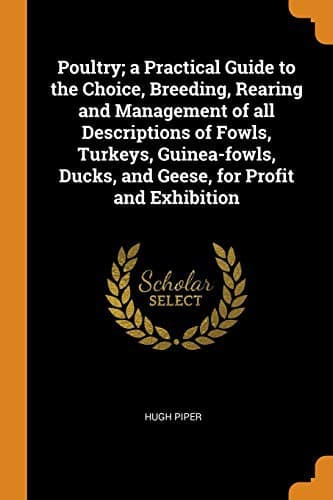
Poultry: A Practical Guide to the Choice, Breeding, Rearing, and Management of all Descriptions of Fowls, Turkeys, Guinea-fowls, Ducks, and Geese, for Profit and Exhibition.Piper, Hugh
Science
Poultry: A Practical Guide to the Choice, Breeding, Rearing, and Management of all Descriptions of Fowls, Turkeys, Guinea-fowls, Ducks, and Geese, for Profit and Exhibition.
Piper, Hugh
Poultry -- Breeding
The NANKIN, or COMMON YELLOW BANTAM, is probably the nearest approach to
the original type of the family--the "Bankiva fowl." The cock "has a
large proportion of red and dark chestnut on the body, with a full black
tail; while the hen is a pale orange yellow, with a tail tipped with
black, and the hackle lightly pencilled with the same colour, and clean
legs. Combs vary, but the rose is decidedly preferable. True-bred
specimens of these birds being by no means common, considerable
deviations from the above description may consequently be expected in
birds passing under this appellation."
The BOOTED BANTAMS have their legs plumed to the toes, not on one side
only like Cochin-Chinas, but completely on both, with stiff, long
feathers, which brush the ground. The most beautiful specimens are of a
pure white. "Feathered-legged Bantams," says Mr. Baily, "may be of any
colour; the old-fashioned birds were very small, falcon-hocked, and
feathered, with long quill feathers to the extremity of the toe. Many of
them were bearded. They are now very scarce; indeed, till exhibitions
brought them again into notice, these beautiful specimens of their tribe
were all neglected and fast passing away. Nothing but the Sebright was
cultivated; but now we bid fair to revive the pets of our ancestors in
all their beauty."
The PEKIN, or COCHIN BANTAMS, were taken from the Summer Palace at Pekin
during the Chinese war, and brought to this country. They exactly
resemble the Buff Cochins in all respects except size. They are very
tame.
The JAPANESE BANTAM is a recent importation, and differs from most of
the other varieties in having a very large single comb. It has very
short well-feathered legs, and the colour varies. Some are quite white,
some have pure white bodies, with glossy, jet-black tails, others are
mottled and buff. They throw the tail up and the head back till they
nearly meet, as in the Fantailed pigeon. They are said to be the
constant companions of man in their native country, and have a droll and
good-natured expression.
All the Bantam cocks are very pugnacious, and though the hens are good
mothers to their own chickens, they will attack any stranger with fury.
They are good layers of small but exquisitely-flavoured eggs. But no
breed produces so great a proportion of unfertile eggs. June is the best
month for hatching, as the chickens are delicate. They feather more
quickly than most breeds, and are apt to die at that period through the
great drain upon the system in producing feathers. When fully feathered
they are quite hardy. The hens are excellent mothers. The chickens
require a little more animal food than other fowls, and extra attention
for a week or two in keeping them dry. Bantams are very useful in a
garden, eating many slugs and insects, and doing little damage.
CHAPTER XIX.
FRENCH AND VARIOUS.
Public-domain text, read in full here on John Shaqi.
Reviews
Reviews
No reviews yet
Be the first to share your thoughts on this work.
Elsewhere in the archive
Join the Discussion
Join the discussion
Sign in to leave a comment or review.
Sign InorCreate an account