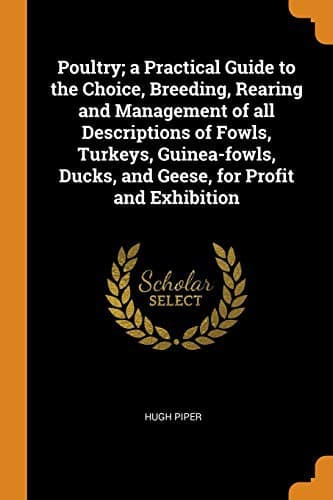
Poultry: A Practical Guide to the Choice, Breeding, Rearing, and Management of all Descriptions of Fowls, Turkeys, Guinea-fowls, Ducks, and Geese, for Profit and Exhibition.Piper, Hugh
Science
Poultry: A Practical Guide to the Choice, Breeding, Rearing, and Management of all Descriptions of Fowls, Turkeys, Guinea-fowls, Ducks, and Geese, for Profit and Exhibition.
Piper, Hugh
Poultry -- Breeding
A good hen will not stay away more than half an hour, unless infested
with vermin, from want of having a proper dust-heap. But hens have often
been absent for more than an hour, and yet have hatched seven or eight
chickens; and instances have been known of their being absent for five
and even for nine hours, and yet hatching a few. The following
remarkable instance is recorded by an excellent authority: "Eggs had
been supplied and a sitting hen lent to a neighbour, and, when she had
set in a granary ten days, she was shut out through the carelessness of
a servant. Being a stranger in the farmyard, the hen was not recognised,
but supposed to have strayed in from an adjoining walk, and thirty hours
elapsed before it was discovered that the hen had left her nest. The
farmer's wife despaired of her brood; but, to her surprise and pleasure,
eight chickens were hatched. The tiled roof of the granary was fully
exposed to the rays of the sun, and the temperature very high, probably
above 80 deg. during the day, and not much lower at night." Valuable
eggs, therefore, should not be abandoned on account of a rather
lengthened absence; and ordinary eggs should not be discarded as
worthless if the hen has already sat upon them for a fortnight or so;
but if she has been sitting for only a few days, it is safer to throw
them away, and have a fresh batch.
During the hen's absence, always look at the eggs, remove any that may
have been broken, and very gently wash any sticky or dirty eggs with a
flannel dipped in milk-warm water. See that they are dry before putting
them back. If the nest is also dirty, replace it with fresh material of
the same kind. Gently drive the hen back to her nest as quickly as
possible, to prevent any damage from the eggs becoming chilled. If a hen
should break an egg with her feet or otherwise, it should be removed as
soon as it is seen, or she may eat it, and, liking the taste, break and
eat the others. Some hens have a bad habit of breaking and eating the
eggs on which they are sitting, to cure which some recommend to boil an
egg hard, bore a few holes in it, so that the inside can be seen, and
give it while hot to the culprit, who will peck at the holes and burn
herself; but hens with such propensities should be fattened for the
table, for they are generally useless either for sitting or laying.
Public-domain text, read in full here on John Shaqi.
Reviews
Reviews
No reviews yet
Be the first to share your thoughts on this work.
Join the Discussion
Join the discussion
Sign in to leave a comment or review.
Sign InorCreate an account