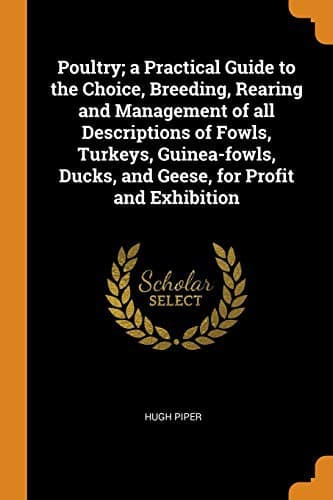
Poultry: A Practical Guide to the Choice, Breeding, Rearing, and Management of all Descriptions of Fowls, Turkeys, Guinea-fowls, Ducks, and Geese, for Profit and Exhibition.Piper, Hugh
Science
Poultry: A Practical Guide to the Choice, Breeding, Rearing, and Management of all Descriptions of Fowls, Turkeys, Guinea-fowls, Ducks, and Geese, for Profit and Exhibition.
Piper, Hugh
Poultry -- Breeding
Let the hen be well fed and supplied with water before putting her on
the nest. Whole barley and soft food, chiefly barley-meal and mashed
potatoes, should be given to her when she comes off the nest, and she
must have as much as she will eat, for she leaves the nest but once
daily, and the full heat of the body cannot be kept up without plenty of
food; or she may have the same food as the general stock. A good supply
of water must be always within her reach. A good-sized shallow box or
pan, containing fine coal-ashes, sand, or dry earth, to cleanse herself
in, should always be ready near to the nest. She should be left
undisturbed, and, as far as possible, allowed to manage her own
business. When a hen shows impatience of her confinement, and frequently
leaves the nest, M. Parmentier advises that half only of her usual meal
should be given, after which she should be replaced on the nest and fed
from the hand with hemp or millet seed, which will induce her to stay
constantly on her eggs. Others will sit so long and closely that they
become faint for want of food. Such hens should not be fed on the nest,
but gently induced with some tempting dainty to take a little exercise,
for they will not leave their eggs of their own accord, and feeding on
the nest has crippled many a good sitter. It is not healthy for the hen
to feed while sitting on or close by the nest, for she requires a little
exercise and rolling in the dust-heap, as well as that the eggs should
be exposed for the air to carry off any of that stagnant vapour which M.
Reaumur proved to be so destructive to the embryo chickens; and it has
also been shown by physiologists that the cooling of the eggs caused by
this absence of the hen is essential to allow a supply of air to
penetrate through the pores of the shell, for the respiration of the
chick. When there are many hens sitting at the same time, it is a good
plan to take them off their nests regularly at the same time every
morning to feed, and afterwards give them an opportunity to cleanse
themselves in a convenient dusting-place, and, if possible, allow them
exercise in a good grass run. A hen should never be caught, but driven
back gently to her nest.
Public-domain text, read in full here on John Shaqi.
Reviews
Reviews
No reviews yet
Be the first to share your thoughts on this work.
Join the Discussion
Join the discussion
Sign in to leave a comment or review.
Sign InorCreate an account