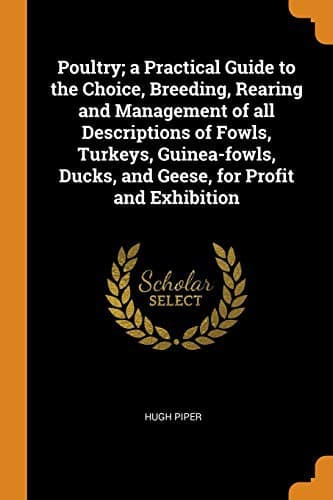
Poultry: A Practical Guide to the Choice, Breeding, Rearing, and Management of all Descriptions of Fowls, Turkeys, Guinea-fowls, Ducks, and Geese, for Profit and Exhibition.Piper, Hugh
Science
Poultry: A Practical Guide to the Choice, Breeding, Rearing, and Management of all Descriptions of Fowls, Turkeys, Guinea-fowls, Ducks, and Geese, for Profit and Exhibition.
Piper, Hugh
Poultry -- Breeding
The choice of breed must depend upon the object for which the fowls are
kept, whether chiefly for eggs or to produce chickens, or for both; the
climate, soil, and situation; the space that can be allotted to them;
and the amount of attention that can be devoted to their care. If fowls
are to be bred for exhibition, you must be guided by your own taste,
pocket, and resources, as well as by the suitability of the situation
for the particular breed desired. The advantages, disadvantages, and
peculiarities of the various breeds will be described under their
respective heads.
In commencing poultry-keeping buy only young and healthy birds. No one
sign is infallible to the inexperienced. In general, however, the legs
of a young hen look delicate and smooth, her comb and wattles are soft
and fresh, and her general outline, even in good condition (unless when
fattened for the table), rather light and graceful; whilst an old one
will have rather hard, horny-looking shanks; her comb and wattles look
somewhat harder, drier, and more "scurfy," and her figure is well filled
out. But any of these signs may be deceptive, and the beginner should
use his own powers of observation, and try and catch the "old look,"
which he will soon learn to know.
All authorities agree that a cock is in his prime at two years of age,
though some birds show every sign of full vigour when only four months
old. It is agreed by nearly all the greatest authorities that the ages
of the cocks and hens should be different; however, good birds may be
bred from parents of the same age, but they should not be less than a
year old. The strongest chickens are obtained from two-year old hens by
a cockerel of about a year old; but such broods contain a disproportion
of cocks, and, therefore, most poultry-keepers prefer to breed from
well-grown pullets of not less than nine months with a cock of two years
of age. The cock should not be related to the hens. It is, therefore,
not advisable to purchase him from the same breeder of whom you procure
the hens. Do not let him be the parent of chickens from pullets that are
his own offspring. Breeding in-and-in causes degeneracy in fowls as in
all other animals. Some birds retain all their fire and energy until
five or even six years of age, but they are beyond their prime after the
third, or at the latest their fourth year; and should be replaced by
younger birds of the same breed, but from a different stock.
Public-domain text, read in full here on John Shaqi.
Reviews
Reviews
No reviews yet
Be the first to share your thoughts on this work.
Elsewhere in the archive
Join the Discussion
Join the discussion
Sign in to leave a comment or review.
Sign InorCreate an account