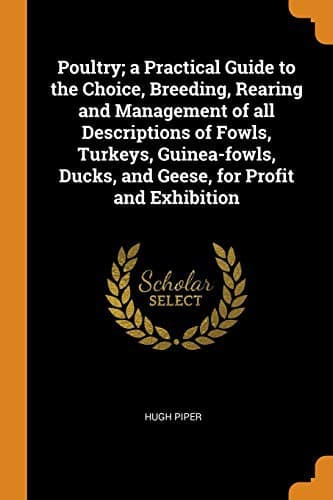
Poultry: A Practical Guide to the Choice, Breeding, Rearing, and Management of all Descriptions of Fowls, Turkeys, Guinea-fowls, Ducks, and Geese, for Profit and Exhibition.Piper, Hugh
Science
Poultry: A Practical Guide to the Choice, Breeding, Rearing, and Management of all Descriptions of Fowls, Turkeys, Guinea-fowls, Ducks, and Geese, for Profit and Exhibition.
Piper, Hugh
Poultry -- Breeding
They are the best of all fowls for a limited space, and not inclined to
wander even when they have an extensive run. They cannot fly, and a
fence three feet high will keep them in. But if kept in a confined space
they must have an unlimited supply of green food. They give us eggs when
they are most expensive, and indeed, with regard to new-laid eggs, when
they are almost impossible to be had at any price. They begin to lay
soon after they are five months old, regardless of the season or
weather, and lay throughout the year, except when requiring to sit,
which they do twice or thrice a year, and some oftener. Pullets will
sometimes lay at fourteen weeks, and want to sit before they are six
months old. Cochins have been known to lay twice in a day, but not again
on the following day, and the instances are exceptional. Their eggs are
of a pale chocolate colour, of excellent flavour, and usually weigh
2-1/4 ounces each. They are excellent sitters and mothers. Pullets will
frequently hatch, lay again, and sit with the chickens of the first
brood around them. Cochins are most valuable as sitters early in the
year, being broody when other fowls are beginning to lay; but unless
cooped they are apt to leave their chickens too soon, especially for
early broods, and lay again. They are very hardy, and their chickens
easy to rear, doing well even in bleak places without any unusual care.
But they are backward in fledging, chickens bred from immature fowls
being the most backward. Those which are cockerels show their flight
feathers earliest. They are very early matured.
A writer in the _Poultry Chronicle_ well says: "These fowls were sent
to provide food for man; by many they are not thought good table fowls;
but when others fail, if you keep them, you shall never want the luxury
of a really new-laid egg on your breakfast table. The snow may fall, the
frost may be thick on your windows when you first look out on a December
morning, but your Cochins will provide you eggs. Your children shall
learn gentleness and kindness from them, for they are kind and gentle,
and you shall be at peace with your neighbours, for they will not wander
nor become depredators. They have fallen in price because they were
unnaturally exalted; but their sun is not eclipsed; they have good
qualities, and valuable. They shall now be within the reach of all; and
will make the delight of many by their domestic habits, which will allow
them to be kept where others would be an annoyance." They will let you
take them off their roost, handle and examine them, and put them back
without struggling.
Public-domain text, read in full here on John Shaqi.
Reviews
Reviews
No reviews yet
Be the first to share your thoughts on this work.
Elsewhere in the archive
Join the Discussion
Join the discussion
Sign in to leave a comment or review.
Sign InorCreate an account