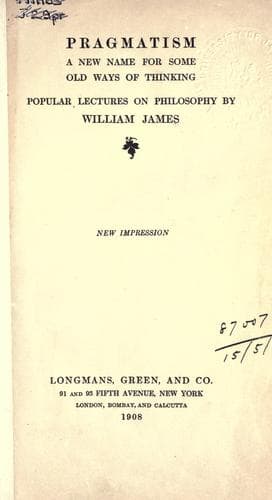
Pragmatism: A New Name for Some Old Ways of ThinkingJames, William
Philosophy
Pragmatism: A New Name for Some Old Ways of Thinking
James, William
Pragmatism
Optimism in turn would be the doctrine that thinks the world's salvation
inevitable.
Midway between the two there stands what may be called the doctrine of
meliorism, tho it has hitherto figured less as a doctrine than as an
attitude in human affairs. Optimism has always been the regnant DOCTRINE
in european philosophy. Pessimism was only recently introduced by
Schopenhauer and counts few systematic defenders as yet. Meliorism
treats salvation as neither inevitable nor impossible. It treats it as
a possibility, which becomes more and more of a probability the more
numerous the actual conditions of salvation become.
It is clear that pragmatism must incline towards meliorism. Some
conditions of the world's salvation are actually extant, and she cannot
possibly close her eyes to this fact: and should the residual conditions
come, salvation would become an accomplished reality. Naturally the
terms I use here are exceedingly summary. You may interpret the
word 'salvation' in any way you like, and make it as diffuse and
distributive, or as climacteric and integral a phenomenon as you please.
Take, for example, any one of us in this room with the ideals which
he cherishes, and is willing to live and work for. Every such ideal
realized will be one moment in the world's salvation. But these
particular ideals are not bare abstract possibilities. They are
grounded, they are LIVE possibilities, for we are their live champions
and pledges, and if the complementary conditions come and add
themselves, our ideals will become actual things. What now are the
complementary conditions? They are first such a mixture of things as
will in the fulness of time give us a chance, a gap that we can spring
into, and, finally, OUR ACT.
Does our act then CREATE the world's salvation so far as it makes room
for itself, so far as it leaps into the gap? Does it create, not the
whole world's salvation of course, but just so much of this as itself
covers of the world's extent?
Here I take the bull by the horns, and in spite of the whole crew of
rationalists and monists, of whatever brand they be, I ask WHY NOT? Our
acts, our turning-places, where we seem to ourselves to make ourselves
and grow, are the parts of the world to which we are closest, the parts
of which our knowledge is the most intimate and complete. Why should
we not take them at their face-value? Why may they not be the actual
turning-places and growing-places which they seem to be, of the
world--why not the workshop of being, where we catch fact in the making,
so that nowhere may the world grow in any other kind of way than this?
Public-domain text, read in full here on John Shaqi.
Reviews
Reviews
No reviews yet
Be the first to share your thoughts on this work.
Elsewhere in the archive
Join the Discussion
Join the discussion
Sign in to leave a comment or review.
Sign InorCreate an account