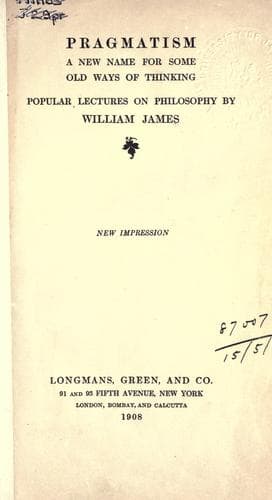
Pragmatism: A New Name for Some Old Ways of ThinkingJames, William
Philosophy
Pragmatism: A New Name for Some Old Ways of Thinking
James, William
Pragmatism
I fear that my previous lectures, confined as they have been to human
and humanistic aspects, may have left the impression on many of you that
pragmatism means methodically to leave the superhuman out. I have shown
small respect indeed for the Absolute, and I have until this moment
spoken of no other superhuman hypothesis but that. But I trust that you
see sufficiently that the Absolute has nothing but its superhumanness
in common with the theistic God. On pragmatistic principles, if the
hypothesis of God works satisfactorily in the widest sense of the word,
it is true. Now whatever its residual difficulties may be, experience
shows that it certainly does work, and that the problem is to build it
out and determine it, so that it will combine satisfactorily with all
the other working truths. I cannot start upon a whole theology at the
end of this last lecture; but when I tell you that I have written a book
on men's religious experience, which on the whole has been regarded as
making for the reality of God, you will perhaps exempt my own pragmatism
from the charge of being an atheistic system. I firmly disbelieve,
myself, that our human experience is the highest form of experience
extant in the universe. I believe rather that we stand in much the same
relation to the whole of the universe as our canine and feline pets
do to the whole of human life. They inhabit our drawing-rooms and
libraries. They take part in scenes of whose significance they have no
inkling. They are merely tangent to curves of history the beginnings and
ends and forms of which pass wholly beyond their ken. So we are tangents
to the wider life of things. But, just as many of the dog's and cat's
ideals coincide with our ideals, and the dogs and cats have daily living
proof of the fact, so we may well believe, on the proofs that religious
experience affords, that higher powers exist and are at work to save the
world on ideal lines similar to our own.
You see that pragmatism can be called religious, if you allow that
religion can be pluralistic or merely melioristic in type. But whether
you will finally put up with that type of religion or not is a question
that only you yourself can decide. Pragmatism has to postpone dogmatic
answer, for we do not yet know certainly which type of religion is going
to work best in the long run. The various overbeliefs of men, their
several faith-ventures, are in fact what are needed to bring the
evidence in. You will probably make your own ventures severally. If
radically tough, the hurly-burly of the sensible facts of nature will
be enough for you, and you will need no religion at all. If radically
tender, you will take up with the more monistic form of religion:
the pluralistic form, with its reliance on possibilities that are not
necessities, will not seem to afford you security enough.
Public-domain text, read in full here on John Shaqi.
Reviews
Reviews
No reviews yet
Be the first to share your thoughts on this work.
Elsewhere in the archive
Join the Discussion
Join the discussion
Sign in to leave a comment or review.
Sign InorCreate an account