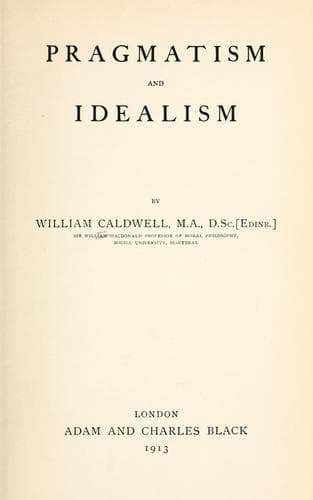
Turning now to the matter of American characteristics that are broader
and deeper than the merely academic, we may find an illustration,
for example, of the American practicality and the love of the
concrete (instead of the abstract or the merely general) in the
following declaration of Professor James that “the whole originality
of Pragmatism, the whole point in it, is its use of the _concrete_
way of seeing. It begins with _concreteness_ and returns and ends
with it.” Of the American love of novelty and of interest we may
find an illustration in the determination of Pragmatism “never to
discuss a question that has absolutely no interest and no meaning to
any one.” Of Pragmatism as an exemplification of the American love
of experiment, and of experimentation, with a view to definite and
appreciable “returns,” we may give the following: “If you fully believe
the pragmatic method you cannot look on any such word, _i.e._ ‘God,’
‘Matter,’ ‘Reason,’ ‘The Absolute,’ ‘Energy,’ and such ‘solving’
names, as closing your quest. You must bring out in each word its
practical cash value, set it at work within the stream of your
experience. It appears less as a solution then than as a programme for
more work and more particularly as an indication of the ways in which
existing realities _may be changed_.” Of the American intolerance for
mere scholarship and book-learning, and of the American inability
to leave any discovery or any finished product alone without some
attempt to “improve” upon it or to put it to some new use, we may
cite the following: “When may a truth go into cold storage in the
encyclopaedias, and when shall it come out for battle?”
Another very strongly marked characteristic of American life is the
thoroughly eclectic and composite character of its general culture
and of the general tone of its public life. American daily life has
become, as it were, a kind of social solvent, a huge melting-pot for
the culture and the habits and the customs of peoples from all over
the earth. This also may be thought of as reflected in the confessedly
complex and amalgam-like character of Pragmatism, in its boast and
profession of being a synthesis and a fusion of so many different
tendencies of human thought. As a juxtaposition, or kind of compound
solution, of such a variety of things as the affirmations of religion,
the hypothetical method of science, realism, romanticism, idealism,
utilitarianism, and so on, it reminds us only too forcibly of the
endless number of social groups and traditions, the endless number of
interests and activities and projects to be seen and felt in any large
American city.
Public-domain text, read in full here on John Shaqi.
Reviews
Reviews
No reviews yet
Be the first to share your thoughts on this work.
Elsewhere in the archive
Join the Discussion
Join the discussion
Sign in to leave a comment or review.
Sign InorCreate an account