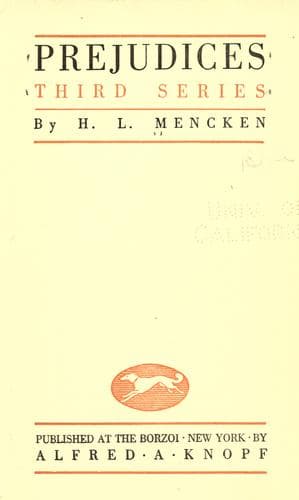
Prejudices, third seriesMencken, H. L. (Henry Louis)
History
Prejudices, third series
Mencken, H. L. (Henry Louis)
American essays -- 20th century; American literature -- History and criticism; Literature -- History and criticism
What ails them primarily is the ignorant and uncritical monomania that
afflicts every sort of fanatic, at all times and everywhere. Having
mastered with their limited faculties the theoretical principles set
forth in the Bill of Rights, they work themselves into a passionate
conviction that those principles are identical with the rules of law
and justice, and ought to be enforced literally, and without the
slightest regard for circumstance and expediency. It is precisely as if
a High Church rector, accidentally looking into the Book of Chronicles,
and especially Chapter II, should suddenly issue a mandate from his
pulpit ordering his parishioners, on penalty of excommunication and the
fires of hell, to follow exactly the example set forth, to wit: “And
Jesse begat his first born Eliab, and Abinadab the second, and Shimma
the third, Netheneel the fourth, Raddai the fifth, Ozen the sixth,
David the seventh,” and so on. It might be very sound theoretical
theology, but it would surely be out of harmony with modern ideas, and
the rev. gentleman would be extremely lucky if the bishop did not give
him 10 days in the diocesan hoosegow.
So with the Bill of Rights. As adopted by the Fathers of the Republic,
it was gross, crude, inelastic, a bit fanciful and transcendental.
It specified the rights of a citizen, but it said nothing whatever
about his duties. Since then, by the orderly processes of legislative
science and by the even more subtle and beautiful devices of juridic
art, it has been kneaded and mellowed into a far greater pliability
and reasonableness. On the one hand, the citizen still retains the
great privilege of membership in the most superb free nation ever
witnessed on this earth. On the other hand, as a result of countless
shrewd enactments and sagacious decisions, his natural lusts and
appetites are held in laudable check, and he is thus kept in order and
decorum. No artificial impediment stands in the way of his highest
aspiration. He may become anything, including even a policeman. But
once a policeman, he is protected by the legislative and judicial arms
in the peculiar rights and prerogatives that go with his high office,
including especially the right to jug the laity at his will, to sweat
and mug them, to subject them to the third degree, and to subdue their
resistance by beating out their brains. Those who are unaware of this
are simply ignorant of the basic principles of American jurisprudence,
as they have been exposed times without number by the courts of first
instance and ratified in lofty terms by the Supreme Court of the
United States. The one aim of the controlling decisions, magnificently
attained, is to safeguard public order and the public security, and
to substitute a judicial process for the inchoate and dangerous
interaction of discordant egos.
Public-domain text, read in full here on John Shaqi.
Reviews
Reviews
No reviews yet
Be the first to share your thoughts on this work.
Elsewhere in the archive
Join the Discussion
Join the discussion
Sign in to leave a comment or review.
Sign InorCreate an account