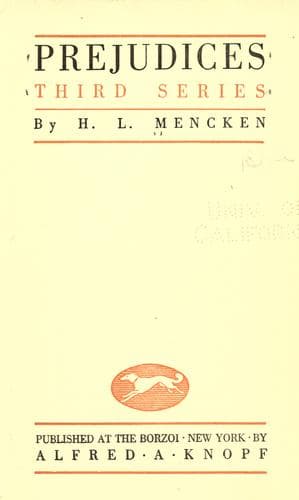
Prejudices, third seriesMencken, H. L. (Henry Louis)
History
Prejudices, third series
Mencken, H. L. (Henry Louis)
American essays -- 20th century; American literature -- History and criticism; Literature -- History and criticism
Thus the law, statute, common and case, protects the free American
against injustice. It is ignorance of that subtle and perfect
process and not any special love of liberty _per se_ that causes
radicals of anti-American kidney to rage every time an officer of the
_gendarmerie_, in the simple execution of his duty, knocks a citizen
in the head. The _gendarme_ plainly has an inherent and inalienable
right to knock him in the head: it is an essential part of his general
prerogative as a sworn officer of the public peace and a representative
of the sovereign power of the state. He may, true enough, exercise that
prerogative in a manner liable to challenge on the ground that it is
imprudent and lacking in sound judgment. On such questions reasonable
men may differ. But it must be obvious that the sane and decorous way
to settle differences of opinion of that sort is not by public outcry
and florid appeals to sentimentality, not by ill-disguised playing to
class consciousness and anti-social prejudice, but by an orderly resort
to the checks and remedies superimposed upon the Bill of Rights by the
calm deliberation and austere logic of the courts of equity.
The law protects the citizen. But to get its protection he must show
due respect for its wise and delicate processes.
X. THE NOVEL
An unmistakable flavor of effeminacy hangs about the novel, however
heroic its content. Even in the gaudy tales of a Rex Beach, with their
bold projections of the Freudian dreams of go-getters, ice-wagon
drivers, Ku Kluxers, Rotary Club presidents and other such carnivora,
there is a subtle something that suggests water-color painting,
lip-sticks and bon-bons. Well, why not? When the novel, in the form
that we know to-day, arose in Spain toward the end of the sixteenth
century, it was aimed very frankly at the emerging women of the
Castilian seraglios—women who were gradually emancipating themselves
from the _Küche-Kinder-Kirche_ darkness of the later Middle Ages, but
had not yet come to anything even remotely approaching the worldly
experience and intellectual curiosity of men. They could now read and
they liked to practice the art, but the grand literature of the time
was too profound for them, and too somber. So literary confectioners
undertook stuff that would be more to their taste, and the modern novel
was born. A single plot served most of these confectioners; it became
and remains one of the conventions of the form. Man and maid meet,
love, and proceed to kiss—but the rest must wait. The buss remains
chaste through long and harrowing chapters; not until the very last
scene do fate and Holy Church license anything more. This plot, as I
say, still serves, and Arnold Bennett is authority for the doctrine
that it is the safest known. Its appeal is patently to the feminine
fancy, not to the masculine. Women like to be wooed endlessly before
they loose their girdles and are wooed no more. But a man, when he
Public-domain text, read in full here on John Shaqi.
Reviews
Reviews
No reviews yet
Be the first to share your thoughts on this work.
Elsewhere in the archive
Join the Discussion
Join the discussion
Sign in to leave a comment or review.
Sign InorCreate an account