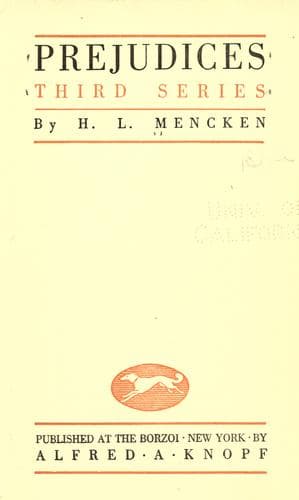
Prejudices, third seriesMencken, H. L. (Henry Louis)
History
Prejudices, third series
Mencken, H. L. (Henry Louis)
American essays -- 20th century; American literature -- History and criticism; Literature -- History and criticism
one direction, such dialectical parables as Dreiser’s “The ‘Genius,’”
H. G. Wells’ “Joan and Peter” and Upton Sinclair’s “King Coal,” and,
in a quite different direction, such rhapsodies as Cabell’s “Jurgen,”
Meredith’s “The Shaving of Shagpat” and Jacob Wassermann’s “The World’s
Illusion.” These things are novels only in the very limited sense
that Beethoven’s “Vittoria” and Goldmarck’s “Ländliche Hochzeit” are
symphonies. Their chief purpose is not that of prose fiction; it is
either that of argumentation or that of poetry. The women novelists,
with very few exceptions, are far more careful to remain within the
legitimate bounds of the form; they do not often abandon representation
to exhort or exult. Miss Cather’s “My Antonia” shows a great deal
of originality in its method; the story it tells is certainly not a
conventional one, nor is it told in a conventional way. But it remains
a novel none the less, and as clearly so, in fact, as “The Ordeal of
Richard Feverel” or “Robinson Crusoe.”
Much exertion of the laryngeal and respiratory muscles is wasted upon
a discussion of the differences between realistic novels and romantic
novels. As a matter of fact, every authentic novel is realistic in
its method, however fantastic it may be in its fable. The primary aim
of the novel, at all times and everywhere, is the representation of
human beings at their follies and villainies, and no other art form
clings to that aim so faithfully. It sets forth, not what might be
true, or what ought to be true, but what actually _is_ true. This is
obviously not the case with poetry. Poetry is the product of an effort
to invent a world appreciably better than the one we live in; its
essence is not the representation of the facts, but the deliberate
concealment and denial of the facts. As for the drama, it vacillates,
and if it touches the novel on one side it also touches the epic on the
other. But the novel is concerned solely with human nature as it is
practically revealed and with human experience as men actually know it.
If it departs from that representational fidelity ever so slightly, it
becomes to that extent a bad novel; if it departs violently it ceases
to be a novel at all. Cabell, who shows all the critical deficiencies
of a sound artist, is one who has spent a good deal of time questioning
the uses of realism. Yet it is a plain fact that his own stature as an
artist depends almost wholly upon his capacity for accurate observation
and realistic representation. The stories in “The Line of Love,” though
they may appear superficially to be excessively romantic, really owe
all of their charm to their pungent realism. The pleasure they give is
the pleasure of recognition; one somehow delights in seeing a mediæval
baron acting precisely like a New York stockbroker. As for “Jurgen,” it
is as realistic in manner as Zola’s “La Terre,” despite its grotesque
fable and its burden of political, theological and epistemological
ideas.
Public-domain text, read in full here on John Shaqi.
Reviews
Reviews
No reviews yet
Be the first to share your thoughts on this work.
Elsewhere in the archive
Join the Discussion
Join the discussion
Sign in to leave a comment or review.
Sign InorCreate an account