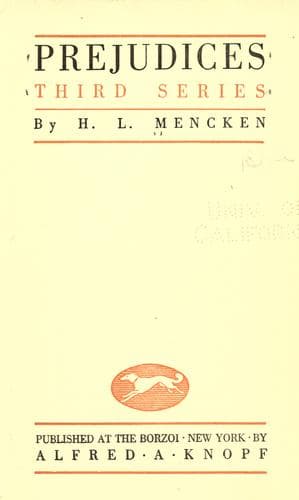
Prejudices, third seriesMencken, H. L. (Henry Louis)
History
Prejudices, third series
Mencken, H. L. (Henry Louis)
American essays -- 20th century; American literature -- History and criticism; Literature -- History and criticism
What ailed the women novelists, until very recently, was a lingering
ladyism—a childish prudery inherited from their mothers. I believe
that it is being rapidly thrown off; indeed, one often sees a concrete
woman novelist shedding it. I give you two obvious examples: Zona Gale
and Willa Cather. Miss Gale started out by trying to put into novels
the conventional prettiness that is esteemed along the Main Streets
of her native Wisconsin. She had skill and did it well, and so she
won a good deal of popular success. But her work was intrinsically as
worthless as a treatise on international politics by the Hon. Warren
Gamaliel Harding or a tract on the duties of a soldier and a gentleman
by a state president of the American Legion. Then, of a sudden, for
some reason quite unknown to the deponent, she threw off all that
flabby artificiality, and began describing the people about her as
they really were. The result was a second success even more pronounced
than her first, and on a palpably higher level. The career of Miss
Cather has covered less ground, for she began far above Main Street.
What she tried to do at the start was to imitate the superficial
sophistication of Edith Wharton and Henry James—a deceptive thing,
apparently realistic in essence, but actually as conventional as table
manners or the professional buffooneries of a fashionable rector.
Miss Cather had extraordinary skill as a writer, and so her imitation
was scarcely to be distinguished from the original, but in the course
of time she began to be aware of its hollowness. Then she turned to
first-hand representation—to pictures of the people she actually
knew. There ensued a series of novels that rose step by step to the
very distinguished quality of “My Antonia.” That fine piece is a great
deal more than simply a good novel. It is a document in the history of
American literature. It proves, once and for all time, that accurate
representation is not, as the campus critics of Dreiser seem to think,
inimical to beauty. It proves, on the contrary, that the most careful
and penetrating representation is itself the source of a rare and
wonderful beauty. No romantic novel ever written in America, by man or
woman, is one-half so beautiful as “My Antonia.”
Public-domain text, read in full here on John Shaqi.
Reviews
Reviews
No reviews yet
Be the first to share your thoughts on this work.
Elsewhere in the archive
Join the Discussion
Join the discussion
Sign in to leave a comment or review.
Sign InorCreate an account