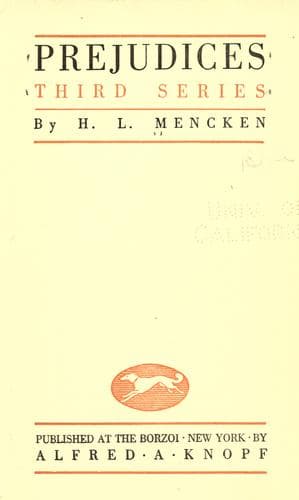
Prejudices, third seriesMencken, H. L. (Henry Louis)
History
Prejudices, third series
Mencken, H. L. (Henry Louis)
American essays -- 20th century; American literature -- History and criticism; Literature -- History and criticism
When the history of the late years in America is written, I suspect
that their grandest, gaudiest gifts to _Kultur_ will be found in the
incomparable twins: the right-thinker and the forward-looker. No other
nation can match them, at any weight. The right-thinker is privy to all
God’s wishes, and even whims; the forward-looker is the heir to all
His promises to the righteous. The former is never wrong; the latter
is never despairing. Sometimes the two are amalgamated into one man,
and we have a Bryan, a Wilson, a Dr. Frank Crane. But more often there
is a division: the forward-looker thinks wrong, and the right-thinker
looks backward. I give you Upton Sinclair and Nicholas Murray Butler
as examples. Butler is an absolute masterpiece of correct thought; in
his whole life, so far as human records show, he has not cherished a
single fancy that might not have been voiced by a Fifth Avenue rector
or spread upon the editorial page of the New York _Times._ But he has
no vision, alas, alas! All the revolutionary inventions for lifting up
humanity leave him cold. He is against them all, from the initiative
and referendum to birth control, and from Fletcherism to osteopathy.
Now turn to Sinclair. He believes in every one of them, however daring
and fantoddish; he grasps and gobbles all the new ones the instant they
are announced. But the man simply cannot think right. He is wrong on
politics, on economics, and on theology. He glories in and is intensely
vain of his wrongness. Let but a new article of correct American
thought get itself stated by the constituted ecclesiastical and secular
authorities—by Bishop Manning, or Judge Gary, or Butler, or Adolph
Ochs, or Dr. Fabian Franklin, or Otto Kahn, or Dr. Stephen S. Wise,
or Roger W. Babson, or any other such inspired omphalist—and he is
against it almost before it is stated.
Public-domain text, read in full here on John Shaqi.
Reviews
Reviews
No reviews yet
Be the first to share your thoughts on this work.
Elsewhere in the archive
Join the Discussion
Join the discussion
Sign in to leave a comment or review.
Sign InorCreate an account