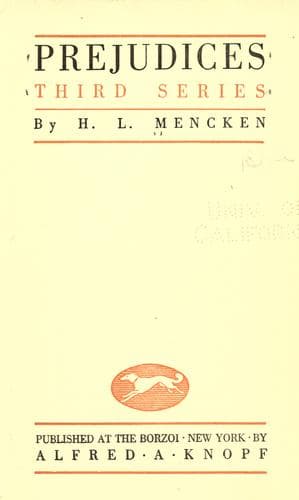
Prejudices, third seriesMencken, H. L. (Henry Louis)
History
Prejudices, third series
Mencken, H. L. (Henry Louis)
American essays -- 20th century; American literature -- History and criticism; Literature -- History and criticism
I have a wide acquaintance among such sad, mad, glad folks, and know
some of them very well. It is my belief that the majority of them are
absolutely honest—that they believe as fully in their baroque gospels
as I believe in the dishonesty of politicians—that their myriad and
amazing faiths sit upon them as heavily as the fear of hell sits upon a
Methodist deacon who has degraded the vestry-room to carnal uses. All
that may be justly said against them is that they are chronically full
of hope, and hence chronically uneasy and indignant—that they belong
to the less sinful and comfortable of the two grand divisions of the
human race. Call them the tender-minded, as the late William James used
to do, and you have pretty well described them. They are, on the one
hand, pathologically sensitive to the sorrows of the world, and, on
the other hand, pathologically susceptible to the eloquence of quacks.
What seems to lie in all of them is the doctrine that evils so vast as
those they see about them _must_ and _will_ be laid—that it would be
an insult to a just God to think of them as permanent and irremediable.
This notion, I believe, is at the bottom of much of the current
pathetic faith in Prohibition. The thing itself is obviously a colossal
failure—that is, when viewed calmly and realistically. It has not only
not cured the rum evil in the United States; it has plainly made that
evil five times as bad as it ever was before. But to confess that bald
fact would be to break the forward-looking heart: it simply refuses
to harbor the concept of the incurable. And so, being debarred by the
legal machinery that supports Prohibition from going back to any more
feasible scheme of relief, it cherishes the sorry faith that somehow,
in some vague and incomprehensible way, Prohibition will yet work.
When the truth becomes so horribly evident that even forward-lookers
are daunted, then some new quack will arise to fool them again, with
some new and worse scheme of super-Prohibition. It is their destiny
to wobble thus endlessly between quack and quack. One pulls them by
the right arm and one by the left arm. A third is at their coat-tail
pockets, and a fourth beckons them over the hill.
Public-domain text, read in full here on John Shaqi.
Reviews
Reviews
No reviews yet
Be the first to share your thoughts on this work.
Elsewhere in the archive
Join the Discussion
Join the discussion
Sign in to leave a comment or review.
Sign InorCreate an account