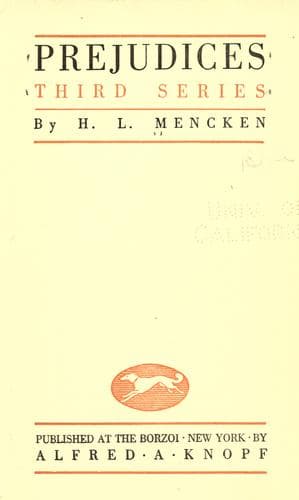
Prejudices, third seriesMencken, H. L. (Henry Louis)
History
Prejudices, third series
Mencken, H. L. (Henry Louis)
American essays -- 20th century; American literature -- History and criticism; Literature -- History and criticism
All these crazes, of course, are primarily artificial. They are
set going, not by the plain people spontaneously, nor even by the
forward-lookers who eventually support them, but by professionals. The
Anti-Saloon League is their archetype. It is owned and operated by
gentlemen who make excellent livings stirring up the tender-minded;
if their salaries were cut off to-morrow, all their moral passion
would ooze out, and Prohibition would be dead in two weeks. So with
the rest of the uplifting camorras. Their present enormous prosperity,
I believe, is due in large part to a fact that is never thought
of, to wit, the fact that the women’s colleges of the country, for
a dozen years past, have been turning out far more graduates than
could be utilized as teachers. These supernumerary lady Ph.D’s almost
unanimously turn to the uplift—and the uplift saves them. In the early
days of higher education for women in the United States, practically
all the graduates thrown upon the world got jobs as teachers, but now
a good many are left over. Moreover, it has been discovered that the
uplift is easier than teaching, and that it pays a great deal better.
It is a rare woman professor who gets more than $5,000 a year, but
there are plenty of uplifting jobs at $8,000 and $10,000 a year, and in
the future there will be some prizes at twice as much. No wonder the
learned girls fall upon them so eagerly!
The annual production of male Ph.D’s is also far beyond the legitimate
needs of the nation, but here the congestion is relieved by the greater
and more varied demand for masculine labor. If a young man emerging
from Columbia or Ohio Wesleyan as _Philosophiez Doctor_ finds it
impossible to get a job teaching he can always go on the road as a
salesman of dental supplies, or enlist in the marines, or study law, or
enter the ministry, or go to work in a coal-mine, or a slaughter-house,
or a bucket-shop, or begin selling Oklahoma mine-stock to widows and
retired clergy-men. The women graduate faces far fewer opportunities.
She is commonly too old and too worn by meditation to go upon the stage
in anything above the grade of a patent-medicine show, she has been so
poisoned by instruction in sex hygiene that she shies at marriage, and
most of the standard professions and grafts of the world are closed to
her. The invention of the uplift came as a godsend to her. Had not some
mute, inglorious Edison devised it at the right time, humanity would
be disgraced to-day by the spectacle of hordes of Lady Ph.D’s going
to work in steam-laundries, hooch shows and chewing-gum factories. As
it is, they are all taken care of by the innumerable societies for
making the whole world virtuous and happy. One may laugh at the aims
and methods of many such societies—for example, at the absurd vereins
for Americanizing immigrants, _i. e._, degrading them to the level of
the native peasantry. But one thing, at least, they accomplish: they
Public-domain text, read in full here on John Shaqi.
Reviews
Reviews
No reviews yet
Be the first to share your thoughts on this work.
Elsewhere in the archive
Join the Discussion
Join the discussion
Sign in to leave a comment or review.
Sign InorCreate an account