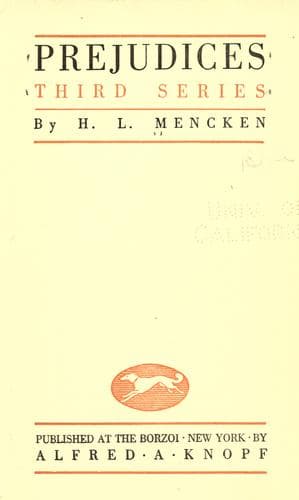
Prejudices, third seriesMencken, H. L. (Henry Louis)
History
Prejudices, third series
Mencken, H. L. (Henry Louis)
American essays -- 20th century; American literature -- History and criticism; Literature -- History and criticism
Faith may be defined briefly as an illogical belief in the occurrence
of the improbable. Or, psychoanalytically, as a wish neurose. There
is thus a flavor of the pathological in it; it goes beyond the normal
intellectual process and passes into the murky domain of transcendental
metaphysics. A man full of faith is simply one who has lost (or never
had) the capacity for clear and realistic thought. He is not a mere
ass: he is actually ill. Worse, he is incurable, for disappointment,
being essentially an objective phenomenon, cannot permanently affect
his subjective infirmity. His faith takes on the virulence of a chronic
infection. What he usually says, in substance, is this: “Let us trust
in God, _who has always fooled us in the past_.”
4
_The Worker_
All democratic theories, whether Socialistic or bourgeois, necessarily
take in some concept of the dignity of labor. If the have-not were
deprived of this delusion that his sufferings in the sweat-shop are
somehow laudable and agreeable to God, there would be little left in
his ego save a belly-ache. Nevertheless, a delusion is a delusion,
and this is one of the worst. It arises out of confusing the pride of
workmanship of the artist with the dogged, painful docility of the
machine. The difference is important and enormous. If he got no reward
whatever, the artist would go on working just the same; his actual
reward, in fact, is often so little that he almost starves. But suppose
a garment-worker got nothing for his labor: would he go on working
just the same? Can one imagine him submitting voluntarily to hardship
and sore want that he might express his soul in 200 more pairs of
pantaloons?
5
_The Physician_
Hygiene is the corruption of medicine by morality. It is impossible to
find a hygienist who does not debase his theory of the healthful with a
theory of the virtuous. The whole hygienic art, indeed, resolves itself
into an ethical exhortation, and, in the sub-department of sex, into a
puerile and belated advocacy of asceticism. This brings it, at the end,
into diametrical conflict with medicine proper. The aim of medicine is
surely not to make men virtuous; it is to safeguard and rescue them
from the consequences of their vices. The true physician does not
preach repentance; he offers absolution.
6
_The Scientist_
Public-domain text, read in full here on John Shaqi.
Reviews
Reviews
No reviews yet
Be the first to share your thoughts on this work.
Elsewhere in the archive
Join the Discussion
Join the discussion
Sign in to leave a comment or review.
Sign InorCreate an account