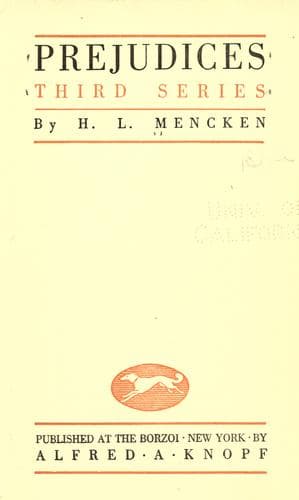
Prejudices, third seriesMencken, H. L. (Henry Louis)
History
Prejudices, third series
Mencken, H. L. (Henry Louis)
American essays -- 20th century; American literature -- History and criticism; Literature -- History and criticism
One of the most mawkish of human delusions is the notion that
friendship should be eternal, or, at all events, life-long, and that
any act which puts a term to it is somehow discreditable. The fact is
that a man of active and resilient mind outwears his friendships just
as certainly as he outwears his love affairs, his politics and his
epistemology. They become threadbare, shabby, pumped-up, irritating,
depressing. They convert themselves from living realities into
moribund artificialities, and stand in sinister opposition to freedom,
self-respect and truth. It is as corrupting to preserve them after
they have grown fly-blown and hollow as it is to keep up the forms
of passion after passion itself is a corpse. Every act and attitude
that they involve thus becomes an act of hypocrisy, an attitude
of dishonesty.... A prudent man, remembering that life is short,
gives an hour or two, now and then, to a critical examination of his
friendships. He weighs them, edits them, tests the metal of them. A
few he retains, perhaps with radical changes in their terms. But the
majority he expunges from his minutes and tries to forget, as he tries
to forget the cold and clammy loves of year before last.
XV. THE DISMAL SCIENCE
Every man, as the Psalmist says, to his own poison, or poisons, as the
case may be. One of mine, following hard after theology, is political
economy. What! Political economy, that dismal science? Well, why not?
Its dismalness is largely a delusion, due to the fact that its chief
ornaments, at least in our own day, are university professors. The
professor must be an obscurantist or he is nothing; he has a special
and unmatchable talent for dullness; his central aim is not to expose
the truth clearly, but to exhibit his profundity, his esotericity—in
brief, to stagger sophomores and other professors. The notion that
German is a gnarled and unintelligible language arises out of the
circumstance that it is so much written by professors. It took a rebel
member of the clan, swinging to the antipodes in his unearthly treason,
to prove its explicitness, its resiliency, it downright beauty.
But Nietzsches are few, and so German remains soggy, and political
economy continues to be swathed in dullness. As I say, however, that
dullness is only superficial. There is no more engrossing book in the
English language than Adam Smith’s “The Wealth of Nations”; surely the
eighteenth century produced nothing that can be read with greater ease
to-day. Nor is there any inherent reason why even the most technical
divisions of its subject should have gathered cobwebs with the passing
of the years. Taxation, for example, is eternally lively; it concerns
ninetenths of us more directly than either smallpox or golf, and has
just as much drama in it; moreover, it has been mellowed and made gay
by as many gaudy, preposterous theories. As for foreign exchange, it is
almost as romantic as young love, and quite as resistent to formulæ.
Public-domain text, read in full here on John Shaqi.
Reviews
Reviews
No reviews yet
Be the first to share your thoughts on this work.
Elsewhere in the archive
Join the Discussion
Join the discussion
Sign in to leave a comment or review.
Sign InorCreate an account