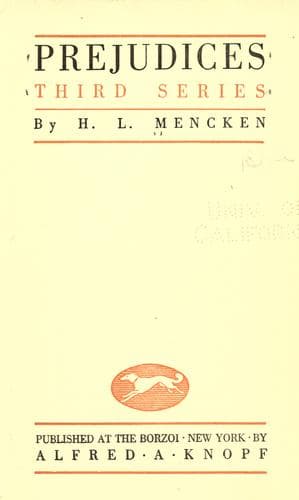
Prejudices, third seriesMencken, H. L. (Henry Louis)
History
Prejudices, third series
Mencken, H. L. (Henry Louis)
American essays -- 20th century; American literature -- History and criticism; Literature -- History and criticism
He may seek the truth and the truth only, and bring up
his highest talents and diligence to the business, but always there is
a specter behind his chair, a warning in his ear. Always it is safer
and more hygienic for him to think one way than to think another way,
and in that bald fact there is excuse enough to hold his whole chain of
syllogisms in suspicion. He may be earnest, he may be honest, but he is
not free, and if he is not free, he is not anything.
Well, are the reverend professors of economics free? With the highest
respect, I presume to question it. Their colleagues of archeology may
be reasonably called free, and their colleagues of bacteriology,
and those of Latin grammar and sidereal astronomy, and those of many
another science and mystery, but when one comes to the faculty of
political economy one finds that freedom as plainly conditioned, though
perhaps not as openly, as in the faculty of theology. And for a plain
reason. Political economy, so to speak, hits the employers of the
professors where they live. It deals, not with ideas that affect those
employers only occasionally or only indirectly or only as ideas, but
with ideas that have an imminent and continuous influence upon their
personal welfare and security, and that affect profoundly the very
foundations of that social and economic structure upon which their
whole existence is based. It is, in brief, the science of the ways and
means whereby they have come to such estate, and maintain themselves
in such estate, that they are able to hire and boss professors. It
is the boat in which they sail down perilous waters—and they must
needs yell, or be more or less than human, when it is rocked. Now
and then that yell duly resounds in the groves of learning. One
remembers, for example, the trial, condemnation and execution of Prof.
Dr. Scott Nearing at the University of Pennsylvania, a seminary that
is highly typical, both in its staff and in its control. Nearing, I
have no doubt, was wrong in his notions—honestly, perhaps, but still
wrong. In so far as I heard them stated at the time, they seemed
to me to be hollow and of no validity. He has since discharged them
from the chautauquan stump, and at the usual hinds. They have been
chiefly accepted and celebrated by men I regard as asses. But Nearing
was not thrown out of the University of Pennsylvania, angrily and
ignominiously, because he was honestly wrong, or because his errors
made him incompetent to prepare sophomores for their examinations; he
was thrown out because his efforts to get at the truth disturbed the
security and equanimity of the rich ignoranti who happened to control
the university, and because the academic slaves and satellites of
these shopmen were restive under his competition for the attention of
the student-body. In three words, he was thrown out because he was
not safe and sane and orthodox. Had his aberration gone in the other
direction, had he defended child labor as ardently as he denounced it
Public-domain text, read in full here on John Shaqi.
Reviews
Reviews
No reviews yet
Be the first to share your thoughts on this work.
Elsewhere in the archive
Join the Discussion
Join the discussion
Sign in to leave a comment or review.
Sign InorCreate an account