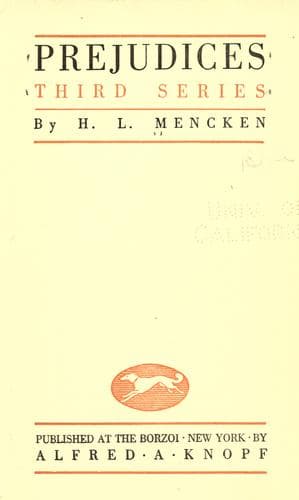
Prejudices, third seriesMencken, H. L. (Henry Louis)
History
Prejudices, third series
Mencken, H. L. (Henry Louis)
American essays -- 20th century; American literature -- History and criticism; Literature -- History and criticism
The drama is the most democratic of the art forms, and perhaps the
only one that may legitimately bear the label. Painting, sculpture,
music and literature, so far as they show any genuine æsthetic or
intellectual content at all, are not for crowds, but for selected
individuals, mostly with bad kidneys and worse morals, and three of the
four are almost always enjoyed in actual solitude. Even architecture
and religious ritual, though they are publicly displayed, make their
chief appeal to man as individual, not to man as mass animal. One goes
into a church as part of a crowd, true enough, but if it be a church
that has risen above mere theological disputation to the beauty of
ceremonial, one is, even in theory, alone with the Lord God Jehovah.
And if, passing up Fifth Avenue in the 5 o’clock throng, one pauses
before St. Thomas’s to drink in the beauty of that archaic façade,
one’s drinking is almost sure to be done _a cappella;_ of the other
passers-by, not one in a thousand so much as glances at it.
But the drama, as representation, is inconceivable save as a show
for the mob, and so it has to take on protective coloration to
survive. It must make its appeal, not to individuals as such, nor
even to individuals as units in the mob, but to the mob as mob—a
quite different thing, as Gustav Le Bon long ago demonstrated in his
“Psychologie des Foules.” Thus its intellectual content, like its
æsthetic form, must be within the mental grasp of the mob, and what is
more important, within the scope of its prejudices. _Per corollary_,
anything even remotely approaching an original idea, or an unpopular
idea, is foreign to it, and if it would make any impression at all,
abhorrent to it. The best a dramatist can hope to do is to give
poignant and arresting expression to an idea so simple that the average
man will grasp it at once, and so banal that he will approve it in the
next instant. The phrase “drama of ideas” thus becomes a mere phrase.
What is actually meant by it is “drama of platitudes.”
Public-domain text, read in full here on John Shaqi.
Reviews
Reviews
No reviews yet
Be the first to share your thoughts on this work.
Elsewhere in the archive
Join the Discussion
Join the discussion
Sign in to leave a comment or review.
Sign InorCreate an account