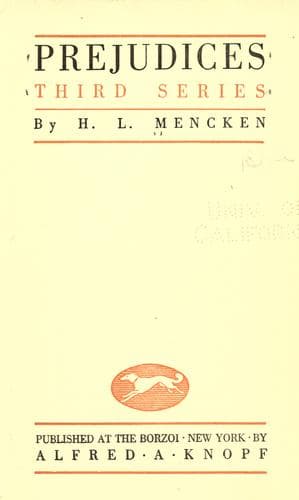
Prejudices, third seriesMencken, H. L. (Henry Louis)
History
Prejudices, third series
Mencken, H. L. (Henry Louis)
American essays -- 20th century; American literature -- History and criticism; Literature -- History and criticism
Ibsen himself, an excellent poet and a reflective man, was under no
delusions about his “dramas of ideas.” It astounded him greatly when
the sentimental German middle-classes hailed “Ein Puppenheim” as a
revolutionary document; he protested often and bitterly against being
mistaken for a prophet of feminism. His own interest in this play
and in those that followed it was chiefly technical; he was trying
to displace the well-made play of Scribe and company with something
simpler, more elastic and more hospitable to character. He wrote
“Ghosts” to raise a laugh against the fools who had seen something
novel and horrible in the idea of “A Doll’s House”; he wanted to prove
to them that that idea was no more than a platitude. Soon afterward he
became thoroughly disgusted with the whole “drama of ideas.” In “The
Wild Duck” he cruelly burlesqued it, and made a low-comedy Ibsenist his
chief butt. In “Hedda Gabler” he played a joke on the Ibsen fanatics by
fashioning a first-rate drama out of the oldest, shoddiest materials
of Sardou, Feuillet, and even Meilhac and Halévy. And beginning with
“Little Eyolf” he threw the “drama of ideas” overboard forever, and
took to mysticism. What could be more comical than the efforts of
critical talmudists to read a thesis into “When We Dead Awaken”? I
have put in many a gay hour perusing their commentaries. Ibsen, had
he lived, would have roared over them—as he roared over the effort
to inject portentous meanings into “The Master Builder,” at bottom no
more than a sentimental epitaph to a love affair that he himself had
suffered at 60.
Gerhart Hauptmann, another dramatist of the first rank, has gone much
the same road. As a very young man he succumbed to the “drama of
ideas” gabble, and his first plays showed an effort to preach this or
that in awful tones. But he soon discovered that the only ideas that
would go down, so to speak, on the stage were ideas of such an austere
platitudinousness that it was beneath his artistic dignity to merchant
them, and so he gave over propaganda altogether. In other words, his
genius burst through the narrow bounds of mob ratiocination, and he
began appealing to the universal emotions—pity, religious sentiment,
patriotism, amorousness. Even in his first play, “Vor Sonnenaufgang,”
his instinct got the better of his mistaken purpose, and reading it
to-day one finds that the sheer horror of it is of vastly more effect
than its nebulous and unimportant ideas. It really says nothing; it
merely makes us dislike some very unpleasant people.
Public-domain text, read in full here on John Shaqi.
Reviews
Reviews
No reviews yet
Be the first to share your thoughts on this work.
Elsewhere in the archive
Join the Discussion
Join the discussion
Sign in to leave a comment or review.
Sign InorCreate an account