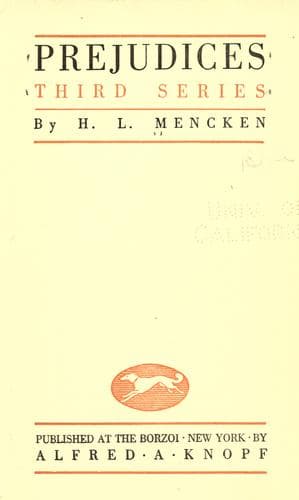
Prejudices, third seriesMencken, H. L. (Henry Louis)
History
Prejudices, third series
Mencken, H. L. (Henry Louis)
American essays -- 20th century; American literature -- History and criticism; Literature -- History and criticism
The notion that there are ideas in the “drama of ideas,” in truth,
is confined to a special class of illuminati, whose chief visible
character is their capacity for ingesting nonsense—Maeterlinckians,
uplifters, women’s clubbers, believers in all the sure cures for
all the sorrows of the world. To-day the Drama League carries on
the tradition. It is composed of the eternally young—unsuccessful
dramatists who yet live in hope, young college professors, psychopathic
old maids, middle-aged ladies of an incurable jejuneness, the
innumerable caravan of the ingenuous and sentimental. Out of the
same intellectual _Landsturm_ comes the following of Bergson, the
parlor metaphysician; and of the third-rate novelists praised by the
newspapers; and of such composers as Wolf-Ferrari and Massenet. These
are the fair ones, male and female, who were ecstatically shocked by
the platitudes of “Damaged Goods,” and who regard Augustus Thomas as
a great dramatist, and what is more, as a great thinker. Their hero,
during a season or two, was the Swedish John the Baptist, August
Strindberg—a lunatic with a gift for turning the preposterous into the
shocking. A glance at Strindberg’s innumerable volumes of autobiography
reveals the true horse-power of his so-called ideas. He believed in
everything that was idiotic, from transcendentalism to witchcraft.
He believed that his enemies were seeking to destroy him by magic;
he spent a whole winter trying to find the philosopher’s stone. Even
among the clergy, it would be difficult to find a more astounding ass
than Strindberg. But he had, for all his folly, a considerable native
skill at devising effective stage-plays—a talent that some men seem
to be born with—and under cover of it he acquired his reputation
as a thinker. Here he was met half way by the defective powers of
observation and reflection of his followers, the half-wits aforesaid;
they mistook their enjoyment of his adept technical trickery for an
appreciation of ideas. Turn to the best of his plays, “The Father.”
Here the idea—that domestic nagging can cause insanity—is an almost
perfect platitude, for on the one hand it is universally admitted
and on the other hand it is not true. But as a stage play pure and
simple, the piece is superb—a simple and yet enormously effective
mechanism. So with “Countess Julie.” The idea here is so vague and
incomprehensible that no two commentators agree in stating it, and yet
the play is so cleverly written, and appeals with such a sure touch to
the universal human weakness for the obscene, that it never fails to
enchant an audience. The case of “Hedda Gabler” is parallel. If the
actresses playing Hedda in this country made up for the part in the
scandalous way their sisters do in Germany (that is, by wearing bustles
in front), it would be as great a success here as it is over there.
Its general failure among us is due to the fact that it is not made
indelicate enough. This also explains the comparative failure of the
Public-domain text, read in full here on John Shaqi.
Reviews
Reviews
No reviews yet
Be the first to share your thoughts on this work.
Elsewhere in the archive
Join the Discussion
Join the discussion
Sign in to leave a comment or review.
Sign InorCreate an account