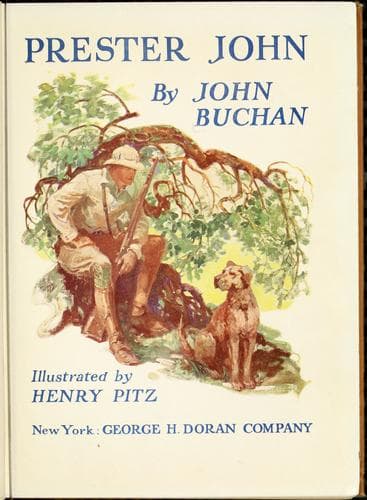
Adventure stories; Clergy -- Fiction; Scots -- South Africa -- Fiction; South Africa -- Fiction; Zulu (African people) -- Fiction
At Bruderstroom, where I was lying unconscious, there were two hundred
men of the police; sixty-three Basuto scouts under a man called
Stephen, who was half native in blood and wholly native in habits; and
three commandoes of the farmers, each about forty strong. The
commandoes were really companies of the North Transvaal Volunteers, but
the old name had been kept and something of the old loose organization.
There were also two four-gun batteries of volunteer artillery, but
these were out on the western skirts of the Wolkberg following Beyers’s
historic precedent. Several companies of regulars were on their way
from Pietersdorp, but they did not arrive till the next day. When they
came they went to the Wolkberg to join the artillery. Along the Berg at
strategic points were pickets of police with native trackers, and at
Blaauwildebeestefontein there was a strong force with two field guns,
for there was some fear of a second Kaffir army marching by that place
to Inanda’s Kraal. At Wesselsburg out on the plain there was a biggish
police patrol, and a system of small patrols along the road, with a
fair number of Basuto scouts. But the road was picketed, not held; for
Arcoll’s patrols were only a branch of his Intelligence Department. It
was perfectly easy, as I had found myself, to slip across in a gap of
the pickets.
Laputa would be in a hurry, and therefore he would try to cross at the
nearest point. Hence it was Arcoll’s first business to hold the line
between the defile of the Letaba and the camp at Bruderstroom. A
detachment of the police who were well mounted galloped at racing speed
for the defile, and behind them the rest lined out along the road. The
farmers took a line at right angles to the road, so as to prevent an
escape on the western flank. The Basutos were sent into the woods as a
sort of advanced post to bring tidings of any movement there. Finally a
body of police with native runners at their stirrups rode on to the
drift where the road crosses the Letaba. The place is called Main
Drift, and you will find it on the map. The natives were first of all
to locate Laputa, and prevent him getting out on the south side of the
triangle of hill and wood between Machudi’s, the road, and the Letaba.
If he failed there, he must try to ford the Letaba below the drift, and
cross the road between the drift and Wesselsburg. Now Arcoll had not
men enough to watch the whole line, and therefore if Laputa were once
driven below the drift, he must shift his men farther down the road.
Consequently it was of the first importance to locate Laputa’s
whereabouts, and for this purpose the native trackers were sent
forward. There was just a chance of capturing him, but Arcoll knew too
well his amazing veld-craft and great strength of body to build much
hope on that.
Public-domain text, read in full here on John Shaqi.
Reviews
Reviews
No reviews yet
Be the first to share your thoughts on this work.
Elsewhere in the archive
Join the Discussion
Join the discussion
Sign in to leave a comment or review.
Sign InorCreate an account