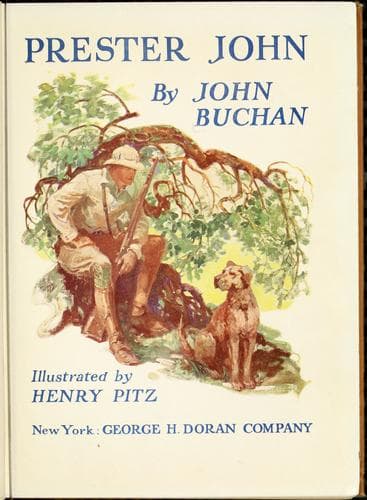
Adventure stories; Clergy -- Fiction; Scots -- South Africa -- Fiction; South Africa -- Fiction; Zulu (African people) -- Fiction
I do not know if he heard me, but at any rate the murderous fit passed.
His hand fell to his side and his great figure tottered out into the
cave. He seemed to be making for the river, but he turned and went
through the door I had entered by. I heard him slipping in the passage,
and then there was a minute of silence.
Suddenly there came a grinding sound, followed by the kind of muffled
splash which a stone makes when it falls into a deep well. I thought
Laputa had fallen into the chasm, but when I reached the door his
swaying figure was coming out of the corridor. Then I knew what he had
done. He had used the remnant of his giant strength to break down the
bridge of stone across the gorge, and so cut off my retreat.
I really did not care. Even if I had got over the bridge I should
probably have been foiled by the shut turnstile. I had quite forgotten
the meaning of fear of death.
I found myself giving my arm to the man who had tried to destroy me.
“I have laid up for you treasure in heaven,” he said. “Your earthly
treasure is in the boxes, but soon you will be seeking incorruptible
jewels in the deep deep water. It is cool and quiet down there, and you
forget the hunger and pain.”
The man was getting very near his end. The madness of despair came back
to him, and he flung himself among the ashes.
“We are going to die together, Crawfurd,” he said. “God has twined our
threads, and there will be only one cutting. Tell me what has become of
my army.”
“Arcoll has guns on the Wolkberg,” I said. “They must submit or
perish.”
“I have other armies ... No, no, they are nothing. They will all wander
and blunder and fight and be beaten. There is no leader anywhere ...
And I am dying.”
There was no gainsaying the signs of death. I asked him if he would
like water, but he made no answer. His eyes were fixed on vacancy, and
I thought I could realize something of the bitterness of that great
regret. For myself I was as cold as a stone. I had no exultation of
triumph, still less any fear of my own fate. I stood silent, the
half-remorseful spectator of a fall like the fall of Lucifer.
“I would have taught the world wisdom.” Laputa was speaking English in
a strange, thin, abstracted voice. “There would have been no king like
me since Charlemagne,” and he strayed into Latin which I have been told
since was an adaptation of the Epitaph of Charles the Great. “_Sub hoc
conditorio_,” he crooned, “_situm est corpus Joannis, magni et
orthodoxi Imperatoris, qui imperium Africanum nobiliter ampliavit, et
multos per annos mundum feliciter rexit._”[1] He must have chosen this
epitaph long ago.
He lay for a few seconds with his head on his arms, his breast heaving
with agony.
“No one will come after me. My race is doomed, and in a little they
will have forgotten my name. I alone could have saved them. Now they go
the way of the rest, and the warriors of John become drudges and
slaves.”
Public-domain text, read in full here on John Shaqi.
Reviews
Reviews
No reviews yet
Be the first to share your thoughts on this work.
Elsewhere in the archive
Join the Discussion
Join the discussion
Sign in to leave a comment or review.
Sign InorCreate an account