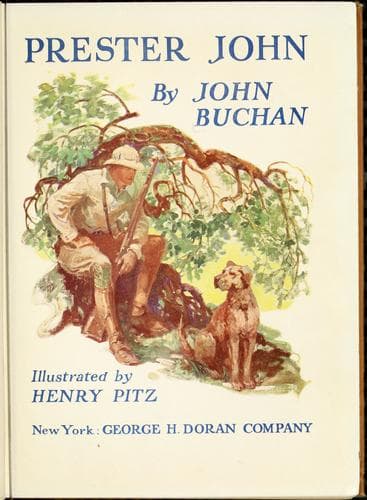
Adventure stories; Clergy -- Fiction; Scots -- South Africa -- Fiction; South Africa -- Fiction; Zulu (African people) -- Fiction
Two years later Aitken found the diamond pipe, which he had always
believed lay in the mountains. Some of the stones in the cave, being
unlike any ordinary African diamonds, confirmed his suspicions and set
him on the track. A Kaffir tribe to the north-east of the Rooirand had
known of it, but they had never worked it, but only collected the
overspill. The closing down of one of the chief existing mines had
created a shortage of diamonds in the world’s markets, and once again
the position was the same as when Kimberley began. Accordingly he made
a great fortune, and to-day the Aitken Proprietary Mine is one of the
most famous in the country. But Aitken did more than mine diamonds, for
he had not forgotten the lesson we had learned together in the work of
resettlement. He laid down a big fund for the education and
amelioration of the native races, and the first fruit of it was the
establishment at Blaauwildebeestefontein itself of a great native
training college. It was no factory for making missionaries and black
teachers, but an institution for giving the Kaffirs the kind of
training which fits them to be good citizens of the state. There you
will find every kind of technical workshop, and the finest experimental
farms, where the blacks are taught modern agriculture. They have proved
themselves apt pupils, and to-day you will see in the glens of the Berg
and in the plains Kaffir tillage which is as scientific as any in
Africa. They have created a huge export trade in tobacco and fruit; the
cotton promises well; and there is talk of a new fibre which will do
wonders. Also along the river bottoms the india-rubber business is
prospering.
There are playing-fields and baths and reading-rooms and libraries just
as in a school at home. In front of the great hall of the college a
statue stands, the figure of a black man shading his eyes with his
hands and looking far over the plains to the Rooirand. On the pedestal
it is lettered “Prester John,” but the face is the face of Laputa. So
the last of the kings of Africa does not lack his monument.
Of this institution Mr Wardlaw is the head. He writes to me weekly, for
I am one of the governors, as well as an old friend, and from a recent
letter I take this passage:—
Public-domain text, read in full here on John Shaqi.
Reviews
Reviews
No reviews yet
Be the first to share your thoughts on this work.
Elsewhere in the archive
Join the Discussion
Join the discussion
Sign in to leave a comment or review.
Sign InorCreate an account