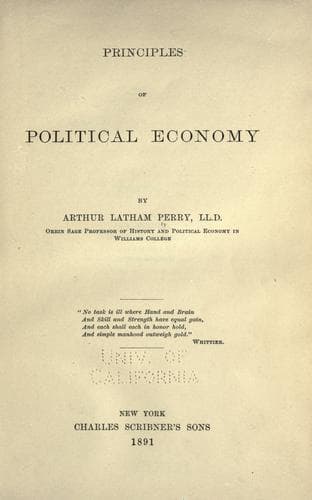
Principles of Political EconomyPerry, Arthur Latham
General
Principles of Political Economy
Perry, Arthur Latham
Economics
(c) If we may trust the simple record in Genesis, the whole earth was
given of God to the whole race, under the direction that they
"_replenish and subdue it_." All the lands were then certainly
valueless, although some of them were doubtless possessed of Utility,
that is, a capacity to gratify human desires through a direct
appropriation, which is a very different thing from Value, which last
is the rendering and receiving of equivalents as between two persons.
It seems very plain, that under this word, "Subdue," and under the
human services implied in that, came in the first idea of ownership in
land. When a family or tribe commenced the work of subjugation upon a
piece of land, when they enclosed it, settled on it, tilled it, in any
way whatever improved it by their own toil, then _could_ first the
idea of ownership dawn upon their minds, then first began that land to
be capable of value, since now that family might reasonably say to
another, If you want this field, you must give us an equivalent for
what we have expended on it to improve it. If the transfer took place,
what was it that was sold? What was it that was paid for by the party
of the second part? It could not be the inherent quality of the soil,
it could not be anything that the first family had gratuitously
entered upon, because similar free land with all its inherent
qualities lay open to occupation on every hand, and the second family
would surely say, For as much effort as you have put upon your land to
better it, we can make other free land as good as yours, consequently
we can give you no more at the most than a fair equivalent for your
efforts already expended. If the parcel were sold, therefore, the
_value_ of it must have been determined, not by the _gratuitous_
elements involved but the _onerous_ elements involved. The physical
thing, land, which cost nothing, has now become the valuable thing,
land, through a series of human efforts expended of such kind as call
out human desires for the results reached, and justify the rendering
of return-services for them; and that which the buyer pays for is
never the free _old_ but always the onerous _new_; new utilities,
that cost something, have been added to and intermixed with old
utilities, that cost nothing; and solely in consequence of this
expenditure of efforts on the part of some men, answering to the
desires and calling out the efforts of other men, do parcels of land
pass out from the first great class into the second great class. So
far as it can be gathered from the nature of the case, and from the
known steps of past experience, this is the simple and rational
process by which valueless lands become valuable, and _less_ valuable
become _more_ valuable lands.
Public-domain text, read in full here on John Shaqi.
Reviews
Reviews
No reviews yet
Be the first to share your thoughts on this work.
Elsewhere in the archive
Join the Discussion
Join the discussion
Sign in to leave a comment or review.
Sign InorCreate an account