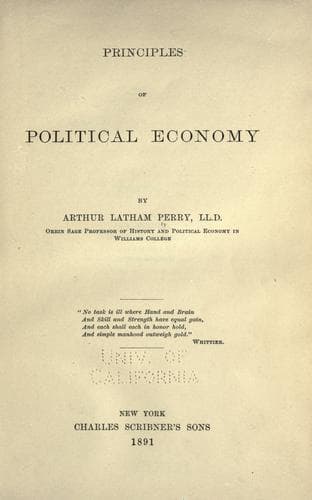
Principles of Political EconomyPerry, Arthur Latham
General
Principles of Political Economy
Perry, Arthur Latham
Economics
But this form of Capital, as well as all other forms of the same, is
perpetually wearing out, that is to say, is gradually losing its power
to contribute as at first to the present and future processes of
production. This loss is in the very nature of things,--in the very
nature of all Capital. The great Father never intended that His
children should cease from work. He has ordered all things so, that
they cannot cease from work, and continue to live in any comfort and
progress. Value, as we have already thoroughly learned, is not a
quality that can be put into anything _to stay there_: it is a
recurring relation of mutual services between man and man; and each of
these services of the three kinds involves recurring Efforts. Capital
is a form of Value; and, consequently, it cannot possibly take on a
shape not subject to the _law of diminishing returns_. This is
deductive proof. And precisely the same result is reached by
Induction. Men have noticed and recorded the fact at all times, and
have made provision for it in their pecuniary calculations, that tools
and machinery need to be repaired and then replaced, that the current
interest on moneyed capital tends to decline from generation to
generation in all progressive countries, and also that lands and other
forms of real estate so lose their productive and rental power unless
cared for in renovation that men migrate and emigrate in consequence.
How much Rent shall the tenant pay to the landlord for the present use
of the latter's old lands? Or in other words, how much shall be added
to the going price of the product on account of the diminishing return
due for the use of the old landed capital? This is a hard question to
answer: probably the hardest question that is ever asked in practical
Economics. Mr. Gladstone wrestled with it as complicated with a larger
political question in passing the Irish Land Bill of 1881. Another
honest athlete, Mr. Parnell, wrestled with it upon the same
parliamentary arena. Scores of able and practical statesmen in Great
Britain, and elsewhere, have struggled to reach a practical answer to
this question; and scores of able and theoretical economists in all
countries have striven to reach a theoretical answer to it. Most of
these answers have been inharmonious, and many of them contradictory,
with each other. The Land Bill of 1881 created a parliamentary
Commission, whose duty and authority it was, to visit the Irish
counties in person, to gain information in detail, to take sworn
testimony of all the parties concerned, and then to lift or lower
rents according to their discretion. The discontent of the Irish
tenants in general was considerably mollified by the action of this
Commission; while the debates and wrangles of the parliamentary
session of 1889, and the persistent agitations for Home Rule (an
agitation at once political and economical), show that the results of
the work of that Commission were not wholly satisfactory.
Public-domain text, read in full here on John Shaqi.
Reviews
Reviews
No reviews yet
Be the first to share your thoughts on this work.
Elsewhere in the archive
Join the Discussion
Join the discussion
Sign in to leave a comment or review.
Sign InorCreate an account