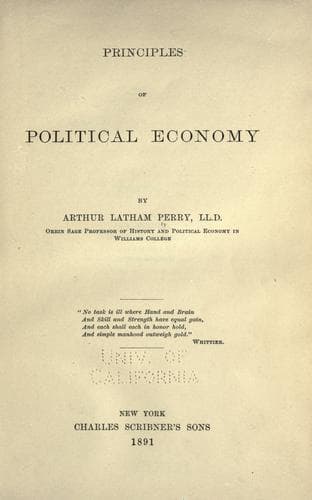
Principles of Political EconomyPerry, Arthur Latham
General
Principles of Political Economy
Perry, Arthur Latham
Economics
Capital is the result of Abstinence from the present use of a Valuable
in gratification, for the sake of a future increase of it through
Production. But Abstinence is always irksome in itself. It must have
its prospective reward in an increase, a profit, or it will never
transform itself from a mere valuable into a capitalized product. Now,
the owner of the valuable, having transformed it into capital from
this motive, is under a commercial necessity to hire laborers, in
order by their help to make his capital yield a profit. Capital lying
idle decreases in _value_ even, to say nothing of its yielding no
increase to itself; and the motive of the capital-owner, accordingly,
is strong and constant to buy the services of laborers, to marry
these services with his own capitalized products, and thus to produce
commodities for sale, whose value shall be greater than the present
value of the capital and the services combined. Here we reach in the
minds and motives of a large class of men an ultimate Demand for
laborers, and specially for skilled laborers, which is as true and
constant to its legitimate end of Profit as the needle is true and
constant to the pole.
At this point it is very evident, that, if the fair expectation of the
capitalists be realized in a steady profit, and the larger the circle
of capitalists and the more of capitalized products to each the better
for all concerned, the Demand for laborers will become steady, and
will be likely to steadily increase, because there will then be a
constant motive on the part of all capitalists as such to put back a
part or all of their yearly profits into capitalized products, and
thus the Demand for laborers will become more intense, and the rates
of Wages so far forth must be enhanced. The steady Demand for the
services of the laborers hinges upon the steady Profits of the
capitalists, and there is no antagonism between the interests of these
two classes of buyers and sellers, but rather a complete identity of
interest between them.
Public-domain text, read in full here on John Shaqi.
Reviews
Reviews
No reviews yet
Be the first to share your thoughts on this work.
Elsewhere in the archive
Join the Discussion
Join the discussion
Sign in to leave a comment or review.
Sign InorCreate an account