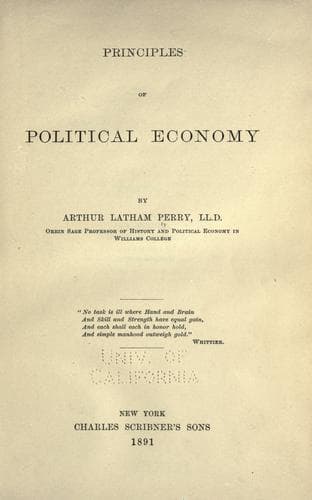
Principles of Political EconomyPerry, Arthur Latham
General
Principles of Political Economy
Perry, Arthur Latham
Economics
It is to be noticed further in respect to physicians, and indeed in
respect to all professional laborers much more than in respect to
other laborers, that much knowledge has been gained by them for its
own sake, out of pure love for it, rather than for the sake of merely
selling their services as laborers; while this does not diminish in
the least the commercial character of their services, it tends to
beget on the part of the buyers of them a stronger confidence in the
men who render them, so that the Demand for such services and
consequently the pay for them is enhanced by the trust reposed in the
laborers on the ground of something acquired by them for other than
selling purposes, and which indeed _cannot be sold_; and superior
_character_ also, as well as superior knowledge, which is wholly
_moral_ in its basis and not mercantile at all, affects the Demand for
the services of the possessor of it to increase it, on the ground of a
naturally stronger trust in him as a professional laborer, and at the
same time tends to increase his Wages by limiting the circle of those
who can offer in competition such services on the background of such
superior knowledge and character.
(b) Lawyers do not meet such a universal Demand in the nature of
things as do physicians. Said Jonathan Smith of Lanesborough in the
Massachusetts Convention of 1788: "We have no lawyer in our town, and
we do well enough without." Still, one hundred years after that time
there were about 70,000 lawyers in the United States, and Lanesborough
itself had had in the meantime at least three distinguished ones. The
interests of property and of reputation, and the constitutional rights
of individuals as over against the claims of Government, so far as
these may be conserved through the agency of lawyers, are by no means
so constant and imperative as are the interests of life and health.
Yet lawyers are in legitimate request in all civilized countries. A
Latin legal maxim announces the obvious truth: _It is the interest of
the Commonwealth that there should be an end of disputes and
litigations._ Beyond question courts and counsel are wholesome on the
whole for the individual and for the commonwealth. But the extremely
complicated and unsatisfactory condition of American Law at present,
owing to the fact that we have a none too simple United States Law
with its three grades of courts and judges, and considerably divergent
bodies of Law in each of 42 States, and owing also to the fact that
our law in general is drawn almost at random from two pretty distinct
Sources, the Common Law of England and the Civil Law of Rome,
multiplies the number of lawyers relatively to the population out of
all proportion to such ratio in other countries, and tends to make the
lawyers as a class too conservative of old and drawn-out processes to
the extent of opposing obvious betterments and simplifications. Said
David Dudley Field, President of the American Bar Association, in
Public-domain text, read in full here on John Shaqi.
Reviews
Reviews
No reviews yet
Be the first to share your thoughts on this work.
Elsewhere in the archive
Join the Discussion
Join the discussion
Sign in to leave a comment or review.
Sign InorCreate an account