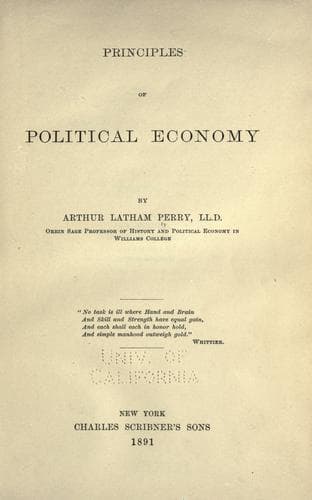
Principles of Political EconomyPerry, Arthur Latham
General
Principles of Political Economy
Perry, Arthur Latham
Economics
For what is sometimes called "literary property" is not property in
the strict sense of the word. A book is not like a plough or a house.
Its contents even when most original have been but colored, as it
were, and rearranged and reinforced by the author's individual mind.
Its substance always comes out of the common stock. It cannot be the
author's own, as the bushel of wheat is the farmer's, who sowed the
seed on his own land and threshed it in his own barn and carried it to
market in his own wagon. The rights of the individual and the rights
of the Community commingle more or less in private property of every
kind, at least to the extent that the latter may tax the property if
needful for the common wellbeing, as it is bound also legally to
secure it to the owner when threatened by others; it is no part of the
purpose of the present book to draw the wavering line in general
between the rights of individuals and the rights of their Government
as towards them; but the distinction between common property and
copyrighted property is plain enough to everybody, and the Law puts
emphasis on the distinction by making the one quickly terminable and
the other continual. So then, when the Government under which the
author resides, has given him a limited copyright within its own
jurisdiction, it would seem as if the individual right in the premises
had been sufficiently recognized alongside of the undoubted right of
the Whole to the ultimate use of the labors of their own citizen.
When, however, it comes to International Copyright, which is an
attempt to secure to authors of one country artificial privileges
under restriction in selling their wares in all other countries, the
argument breaks down. Even for the one country, in which the author
lives and is taxable, the argument is not very strong, and hardly
binds advanced public opinion either as to the grounds of it or even
the practical benefits of it on the whole. By the attempted extension
of it to all countries, its reasonableness disappears. Taxation cannot
extend beyond the jurisdiction of the country taxing; and it certainly
seems as if a legal privilege, beyond common law privileges, ought not
by extension through the formal action of other countries to exempt
from taxation (in case it were needful) the results of the original
privilege. The purpose of International Copyright is not the blessed
one as announced to the world by James Smithson, "_the increase and
diffusion of knowledge among mankind_," but directly and artificially
by means of legal restrictions the "increase" of the prices of books
and of other "knowledge" to the masses of "mankind," and the
"diffusion" of these extra prices as between authors and publishers.
Protectionism does not seem to be one whit more respectable in this
form than in the form of tariff-taxes on foreign works of art.
Public-domain text, read in full here on John Shaqi.
Reviews
Reviews
No reviews yet
Be the first to share your thoughts on this work.
Elsewhere in the archive
Join the Discussion
Join the discussion
Sign in to leave a comment or review.
Sign InorCreate an account