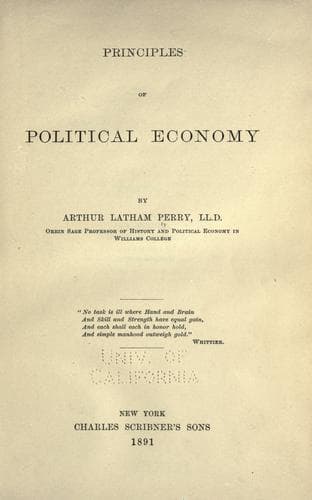
Principles of Political EconomyPerry, Arthur Latham
General
Principles of Political Economy
Perry, Arthur Latham
Economics
(a) The _agreeableness_ or disagreeableness of rendering a given set
of services will affect the Supply of laborers at that point, and help
to determine the rate of Wages paid to them; because the more
agreeable employment will attract the larger number of laborers, will
experience in consequence the press of competition, and the rate of
wages then and there will be lessened thereby. The more disagreeable
employment will feel less the pressure of numbers, and will secure,
other things being equal, a higher rate of remuneration in
consequence. Among the elements which, in spite of diversity of
tastes, make any employment agreeable or disagreeable to the laborers,
are (1) the less or greater exertion of physical strength required,
(2) the healthfulness or unhealthfulness of the service, (3) its
cleanliness or dirtiness, (4) the degree of liberty or confinement in
it, (5) the safety or hazard of the employment, (6) the esteem or
disrepute of it in public opinion. To illustrate each of these in
order, the stone-mason, the glass-blower, the scavenger, the factory
operative, the worker in a powder-mill, the smuggler, will each
receive a larger compensation owing to the peculiar element of
disagreeableness involved in his own personal service; and he will be
able to demand and secure the higher rate through the action of this
disagreeableness upon the Supply of such laborers. Of all these
elements, public opinion is perhaps the most operative; and if this be
favorable to an employment, and some social consideration be attached
to it, and only common qualifications be required for it, the wages in
it will infallibly be low. This is doubtless the main reason why so
many young women prefer to teach, rather than be employed in mills or
shops or offices, and why the wages of female teachers have been so
remarkably low; although each of the elements of agreeableness
specified above may also contribute something towards the same result.
If a business be decidedly opposed to public opinion, it must hold out
the inducement of a large reward, or nobody will engage in it. This
explains the abnormal gains of the slave-trade, the liquor-business,
of gambling-houses, and of lotteries.
Public-domain text, read in full here on John Shaqi.
Reviews
Reviews
No reviews yet
Be the first to share your thoughts on this work.
Elsewhere in the archive
Join the Discussion
Join the discussion
Sign in to leave a comment or review.
Sign InorCreate an account