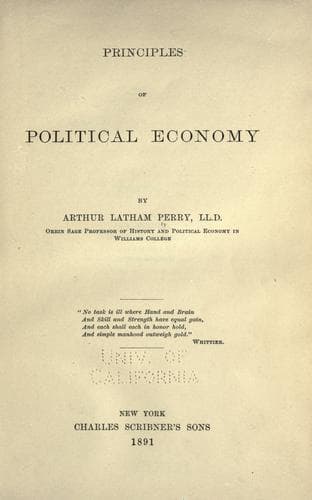
Principles of Political EconomyPerry, Arthur Latham
General
Principles of Political Economy
Perry, Arthur Latham
Economics
(c) The _constancy_ or inconstancy of prospective employment in a
given business, is a consideration that affects the Supply within it,
and then the wages. If the services be of such a character, that they
can only be carried on during nine months of the year, the wages of
the renderers will be greater by the day or the month than they would
be, provided the services were in order during all the twelve months.
The laborer is apt to look at the aggregate earnings of the year, and
will hardly take up a trade which affords employment but a part of the
time, unless some compensation can be found in the higher wages for
that time. This is the chief reason why the wages of the mason and
house-painter, in this climate at least, are higher than those of the
blacksmith and carpenter. The coachman, also, may stand by his horses
half the day or night with no call for his services, and must have,
therefore, a proportionably higher fare from those whom he does
transport. In general, it is found that men prefer a constant
rendering with a lower rate of pay, than an inconstant one with a
prospect of larger wages for the particular jobs actually done; and
because the many prefer that, those who take up with the other are
able to secure a higher relative rate of pay in their less eligible
vocation. It must be noticed, however, as counterworking this, that
some men have desire for intervals of leisure in their business, and
for opportunity to make these intervals subservient to some avocation
or other means of livelihood.
Public-domain text, read in full here on John Shaqi.
Reviews
Reviews
No reviews yet
Be the first to share your thoughts on this work.
Elsewhere in the archive
Join the Discussion
Join the discussion
Sign in to leave a comment or review.
Sign InorCreate an account